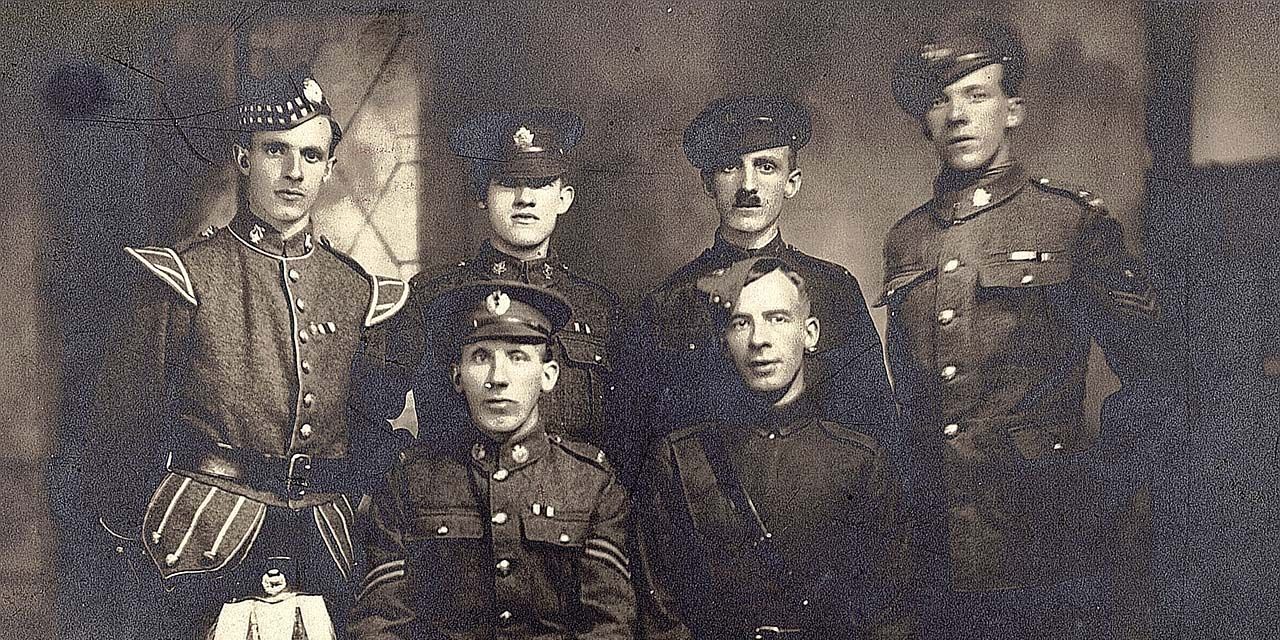
The six Ridgway brothers. Back row, from left: Frederick, Laurence, John and Tom; front row: George and Ernest. Photograph courtesy of the Saunders Family.
The Brothers Who All Came Home
Script by Ken Maher | Stories from Another Day, a Collingwood Museum Podcast. Photos courtesy of the Collingwood Museum
From a Manchester mill town to the shores of Georgian Bay—and then to war. Six brothers enlisted. Remarkably, all six came home.
Sunday, July 26, 1936, dawned warm and sunny in northern France—a day that reminded the Canadian man of his summers by Georgian Bay. He adjusted his dress uniform one last time and wondered how hot it would become. It was too important a day to let discomfort show, because today was the day that King Edward VIII would unveil the Vimy Ridge Memorial. Today, the dead would be honoured, 60,000 Canadian sacrifices remembered, and a site once of only death and destruction would be, as some would mark it, the crucible upon which the nation of Canada was forged. Over 6,000 Canadian pilgrims had made the trip to honour the sons and the daughters of a proud nation. With them that day, another 50,000 to 100,000 French citizens would come to express their praise and thanksgiving.
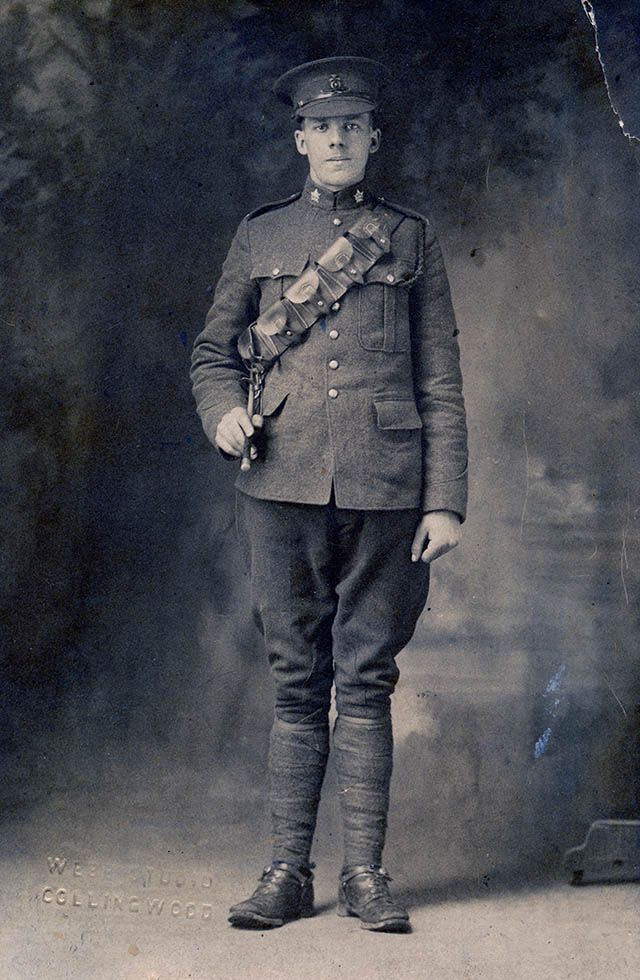
And so it was that a son of Collingwood, Thomas Ridgway, found himself a part of the King’s own honour guard. Tom, who had enlisted into the 2nd Canadian Divisional Ammunition Column on February 21, 1915, became a decorated soldier over the next three years, serving in France, including right there at Vimy Ridge, before being recruited for the top-secret Dunsterforce and sent to Baku, Azerbaijan. There he would join another son of Collingwood, William Thomas Brophy, along with dozens of other Canadians, in a series of adventures that Lisa Smedman describes in her article “Dunsterforce,” for the Vancouver Courier, as rivalling those of Lawrence of Arabia. Lawrence of Arabia, by the way, is himself connected to Collingwood in that… well, that is a story for another day.
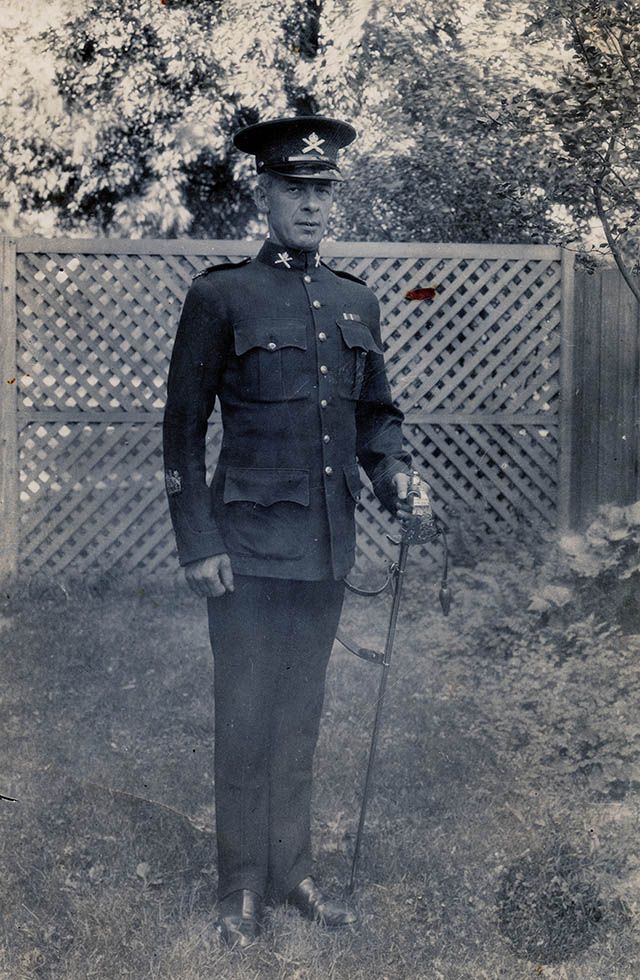
Ernie Ridgway in later years. Photograph courtesy of the Saunders Family.
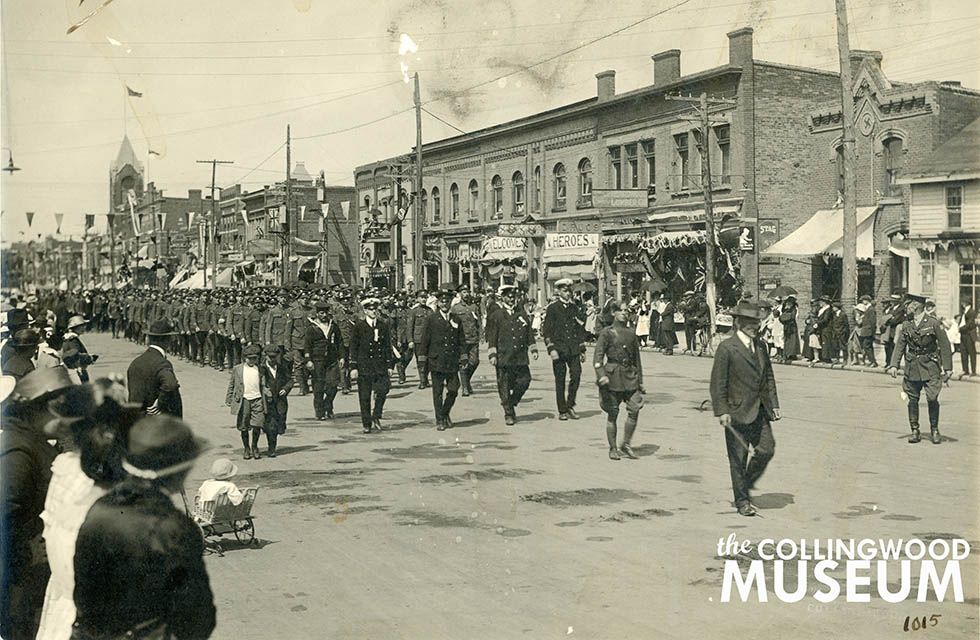
Ernie Ridgway leads Collingwood’s Welcome Home Parade down Hurontario Street on August 21, 1919. He is pictured directly behind the man carrying a cane. Collingwood Museum Collection, X970.666.1; Huron Institute Collection No. 1015.
Tom Ridgway, photographed in Collingwood
by A. S. Webb. Photograph courtesy of the Saunders Family.
But that was then, Tom thinks—a lifetime ago. Today he is back at Vimy to pay tribute to the men who didn’t return home—the men, many of whom he had known personally, who lay there under the soil. And so it was, with proper spit and polish, he was there when the King arrived at 2:15 in the afternoon. Tom stood proudly for the singing of “God Save the King” and “O Canada.” He teared up, as did so many around him, at the sound of the 21-gun salute. He heard firsthand what his family and the rest of Canada back home would only hear over the radio: a roar as you never heard before in war or in peace, when the King broke with decorum and made his way over to the veterans in attendance, to walk among them for more than half an hour and talk with those who still bore the scars and the losses of the Great War.
And through it all, Tom couldn’t help but wonder what his own parents, Joseph and Lucy, would have thought if they could have seen him that day. They were both gone now—his mother a dozen years already, and his father having died not quite a year before. For all its pomp and its ceremony, for all the pageantry and celebration of that Vimy Ridge unveiling, his parents would not have enjoyed this day and its parades any better than the day that Collingwood held its own day to welcome home its sons and daughters from the war. For the Ridgway family, there never was a better day than that one.
But to understand that story, we need to go back to 1907, when then middle-aged Joseph Ridgway and his wife, Lucy Jennings, emigrated from the Manchester area of England to Collingwood to provide a better opportunity—not for themselves, but for their six sons and three daughters. It was said that Joseph chose Collingwood, of all the places in Canada, because of our shipyards; he thought it would provide good jobs for his sons and their families. Upon arriving in town, Joseph, aged 51, worked as a watchman at various factories in Collingwood, including the meat packing plant and Imperial Steel and Wire. Later in life he would also work for a time as a baggage man on the Grand Trunk Railway. In fact, he would do this until the day he retired.
The Ridgway family was never rich, but they were hardworking— indeed, a working-class family who quickly set down deep roots in the community they came to love. They were firmly established then as an important part of local life when war was declared in Europe. The call to serve King and Country was answered by every one of the six Ridgway sons.
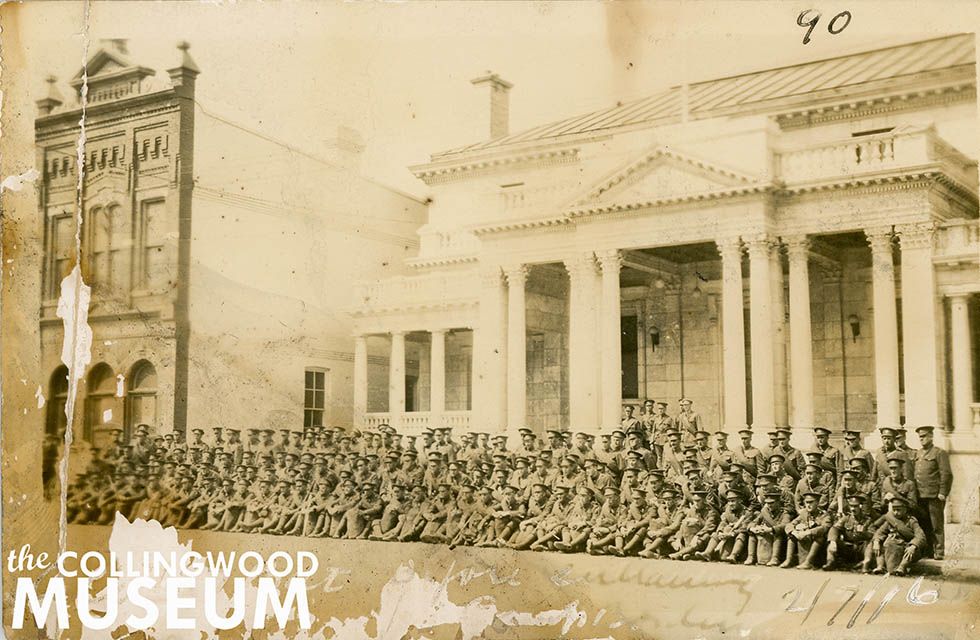
Members of the 157th Battalion were photographed in front of Collingwood’s newest downtown landmark, the Federal Building, on July 7, 1916, in preparation for their departure to Camp Borden for training. Ernie Ridgway served with the 157th Overseas Battalion as a mechanic hand. Collingwood Museum Collection, X2009.86.1; Huron Institute Collection No. 90.
Tom, the first of the brothers whom we have already met, served right to the end of the war. And after coming home, he would go on to take a job as chauffeur to Sir Henry Pellatt. Sir Henry was the builder of Toronto’s landmark Casa Loma. Later in life, when fortune left Sir Henry and dark days fell on the man who had once been the “toast of Toronto,” it was Tom and his small family that took in Sir Henry to live with them. Sir Henry would stay with Tom and his family until the day he died.
The second brother, Ernest Ridgway, who went by “Ernie,” enlisted in 1915. He would be discharged the following year, due to a bout of pneumonia that exacerbated his pre-existing asthma. While Tom would get all the fame, Ernie attained the highest rank of the Ridgway brothers, becoming a regimental sergeant major. Ernie was also given the honour of leading Collingwood’s Welcome Home Parade. Following the war, Ernie moved to Toronto and worked for City Hall. His wife, Phyllis, would go on to become Canada’s oldest person, dying in 2021 at the age of 114, according to Global News.
George Herbert Ridgway, who was “Bert” to those who knew him, had served with the 35th Simcoe Foresters, gaining the rank of sergeant. He enlisted in 1916 and served with the Canadian Engineers in England until April 1919. Bert had three children, ages four, seven, and nine, when he went overseas. Earlier illnesses had given him chronic bronchitis, but it didn’t keep him from serving out the war. Following his return, Bert moved to Hamilton with his family.
Brother number four, Laurence Ridgway, “Laurie” to family and friends, served in the 37th Battalion. Upon returning from the war, he moved first to Toronto and then later to Halifax, where he would live out his days.
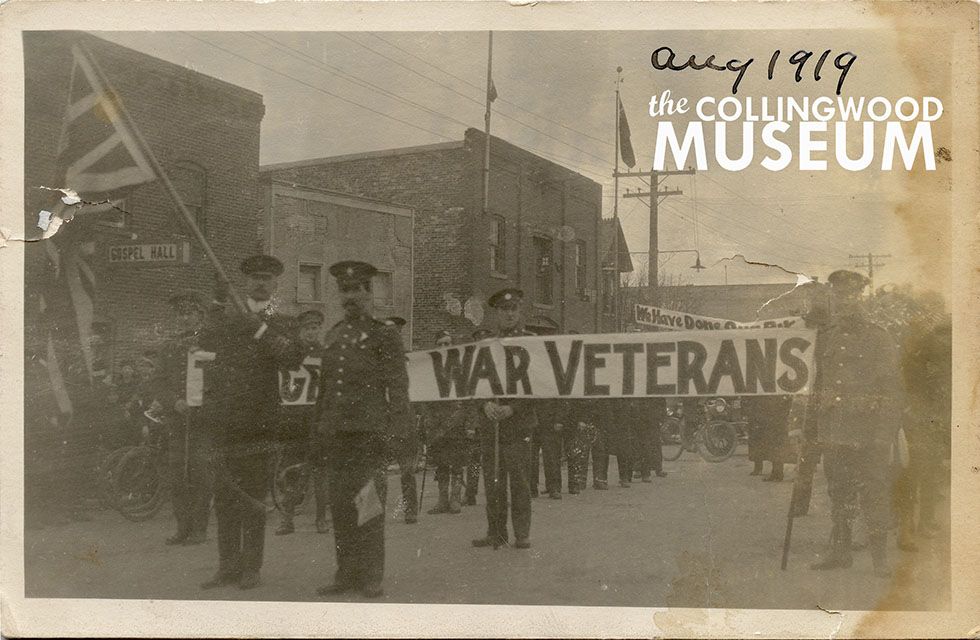
A Great War Veterans Association banner appears during Collingwood’s 1919 Welcome Home Parade. Collingwood Museum Collection, X968.963.1.
Brother five, Frederick Edgar Ridgway, known as “Fred,” enlisted in 1915 and served in France and Belgium until a right-arm fracture sent him home in January 1917. Back in Collingwood, Frederick exchanged his military uniform for a band uniform and went on to play in our own Kiltie Band. Family tradition also credits him with saving the life of a fellow Collingwood soldier by pulling him out of the mud on the battlefield. That soldier, Elwin Bicknell, who—if the story is true (and family should know)—would later turn out to become his very own brother-in-law. After a time, Frederick and his family moved to Niagara Falls.
And that leads us to the last of the six brothers to serve his country in World War I, John William Ridgway. Before the war, John worked on the S.S. Germanic, in the shipyard, and as a guard on the Welland Canal. He enlisted in 1917 and served in the Medical Corps before being discharged in June 1918 due to chronic rheumatism. Because of this, John was the only brother who did not go overseas, but his heart was always here in Collingwood, and John served his community just as capably by being here. Afterward, he was caretaker at the Collingwood Terminals and Collingwood’s Federal Building. He also became assistant curator of the Huron Institute, forerunner of today’s Collingwood Museum. John was also fondly remembered for his long service as sexton at All Saints’ Anglican Church.
Remarkable enough as that courage and sacrifice are, the homecoming parade for Collingwood’s sons and daughters in 1919, at the end of the war, would be the day of greatest joy for Joseph and Lucy and the extended Ridgway family, for every one of their six brave sons made it home again when so many of their compatriots did not.
And that, I think, is what makes the story of the Ridgway family so worth telling and remembering. To my mind, all that we have and all that we enjoy to this day was created and given to us by those who were willing to stand up and protect a way of life worth defending, a community worth serving, a family worth loving. E