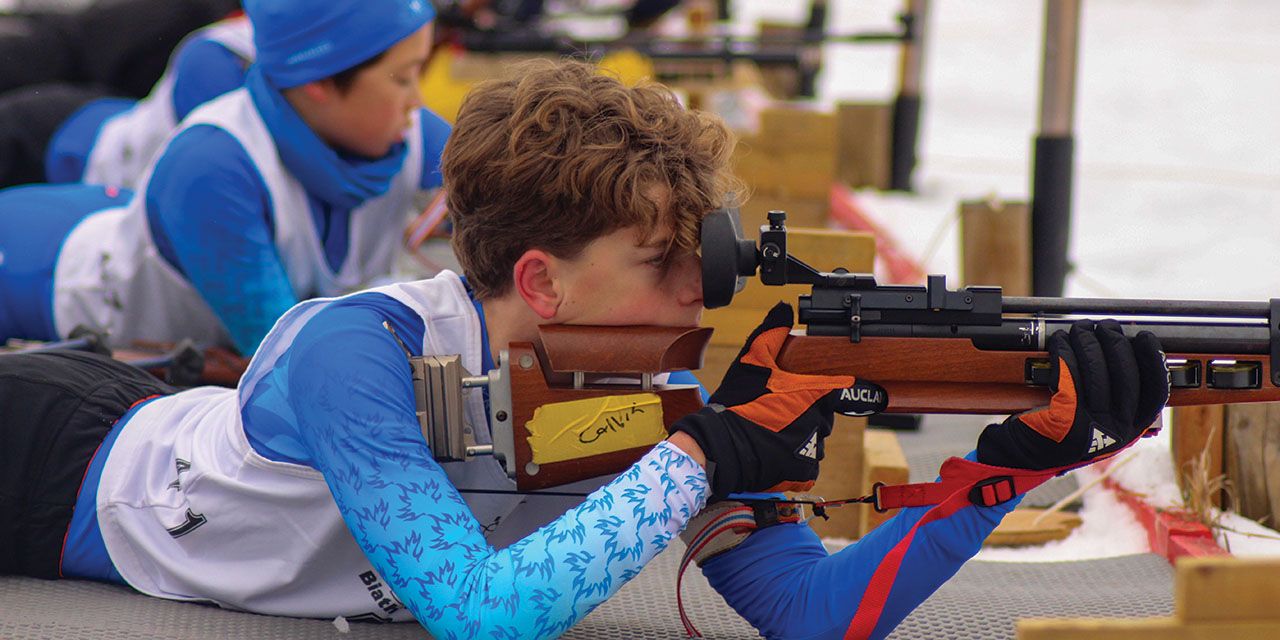
Athlete Calvin Curtis and teammates at Highlands Nordic. Photo by Malcolm McCulloch.
Focus Under Pressure
By Kate MacLennan
Biathlon has flown largely under the radar in Canada, but its merits for physical and mental health are finally bringing it into sharper focus.
Erich Kriegler was a KGB assassin, a henchman to a notorious Greek smuggler, and a champion biathlete. He was also fictional, a key antagonist in For Your Eyes Only, the 1981 offering from producer Albert R. Broccoli for the James Bond film franchise. Through Kriegler (played by British actor John Wyman), the movie glamorized biathlon in a way only the Bond franchise could. Much of it was filmed in Italy’s picturesque Cortina d’Ampezzo ski resort, against backdrops including the 1956 Winter Olympic Ice Stadium and ski jump. But Bond is famous for fast car chases, ultra-tech gadgets, and martinis (shaken, not stirred), so biathlon was a curious addition to the plotline… or was it?
After 1979’s Moonraker, generally accepted to be the most sci-fi of the Bond catalogue, Broccoli’s creative team was keen to re-ground the franchise, literally and metaphorically. They also wanted to capitalize on some piqued public interest in biathlon following the 1980 Winter Games (in Lake Placid, USA), where the faster, shorter 10-kilometre sprint race debuted. More telling in the decision to include biathlon, though, is the realization that an accomplished assassin and an accomplished biathlete share practically the same skill sets. As cinematic opponents, they’re optimally paired for a convincingly good fight.
Stay with me here: like 007, a biathlete requires extreme mental fortitude, physical prowess, highly skilled marksmanship, and, most critically, the ability to achieve perfect stillness on command—even when the blood is pumping; even when the heart is pounding; especially when lying prone in the cold and firing a rifle to hit five targets 50 metres away as quickly as possible.
The motivation of the assassin and the biathlete is, obviously, quite different. In short, biathlon involves endurance crosscountry skiing over undulating terrain, followed by precision target shooting. When you consider the peaceful virtues of cross-country skiing, one could argue it’s the world’s most benign sport, but the inclusion of guns—well, they can throw the uninitiated off the trail.
“People hear ‘shooting’ and think, ‘Oh no!’ They think it’s dangerous,” says Talena Kraus, program manager at Hardwood Ski and Bike in Oro-Medonte, whose biathlon introductory youth program uses air rifles—not .22s. “There’s nothing to be afraid of. You don’t need a licence to shoot one; they are easy to fire, and their pellets don’t go at high speed. You’d have to really, really work hard to cause damage with one.”
For its youth biathlon programs, the Highlands Trailblazers club in Duntroon uses air rifles in addition to optical rifles. Chris Skelton, head biathlon coach for the Trailblazers, explains: “It’s basically a camera system that looks like a rifle and points and shoots like one, but it’s taking a picture of the target. The ‘rifle’ is networked to a computer that figures out where the shot has landed. The target displays if it’s a hit or a miss, just like a bullet hitting a steel target. It’s completely safe and can be set up anywhere, inside or outside, in any setting.”
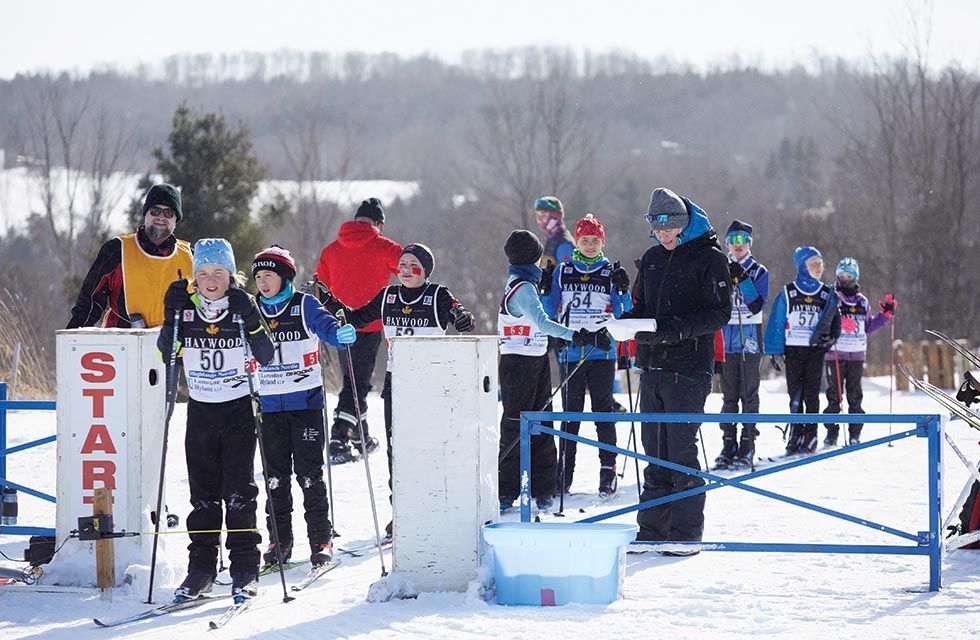
Athletes push out of the start gate during a 2025 O Cup race at Highlands Nordic. Photo by Christina Gutmanis.
All the club’s biathletes start out on this system, regardless of age, and, with time and training, may graduate to using the traditional—very specialized, ultra-lightweight—.22-calibre rifles that competitive biathletes use.
Whether biathlon has been misunderstood or just underrepresented in popular culture, it has remained highly niche since its first recorded competition in the mid-18th century. The sport is said to pay homage to the mythological Norse god Ullr, a skilled skier and archer. It has been included in the Winter Olympic Games since 1960 and enjoys a much larger following in Europe and Scandinavia than here in North America. (Little surprise that biathlon’s “GOAT” is widely considered to be a Norwegian: Ole Einar Bjørndalen.) “Given how much winter we have, it’s surprising it’s not more well known here,” Kraus says, then adds, “but that’s changing.”
Being limber is a real asset in biathlon, perhaps explaining why older people are less inclined to take it up. Flexibility and agility, however, aren’t an issue for the critical group in the sport’s growth: kids. Hardwood has had a biathlon program for over a decade. This winter, it had to cap its 2025/2026 youth program, the Biathlon Bears (kids aged 9 to 14), after receiving its largest registration to date.
“Quite a few of our biathletes went through our Nordic kids’ ski program. Once they can skate ski—biathlon is skate skiing, not classic cross-country—they can try biathlon. They learn all the safety features, how to lie down wearing their skis, pump the rifle, account for the wind, and hit the target. They learn how much focus and attention to detail and fine motor skills are required.
They go from this highly aerobic activity in the cold and then stop, and slow down so completely that they can aim and hit a target,” explains Kraus.
The sport offers an enticing antithesis for an increasingly frenetic, indoor, on screen, and fast-paced, information-driven world. “Most people, after meeting a biathlete, will comment, ‘Wow, these kids seem so together and calm and thoughtful.’ It’s because this sport really rewards that,” says Skelton.
Across its biathlon programs, Highlands Trailblazers has seven coaches working with athletes ranging from ages eight to 18. It built a .22 range—the only biathlon-specific facility in Ontario— in 2020. “We’re playing catch-up with Alberta and B.C. in terms of facilities and programs. Out west, adult recreational biathlon is huge. It’s not uncommon out there to have 40 or 50 masters athletes—some over age 70—competing in a race.”
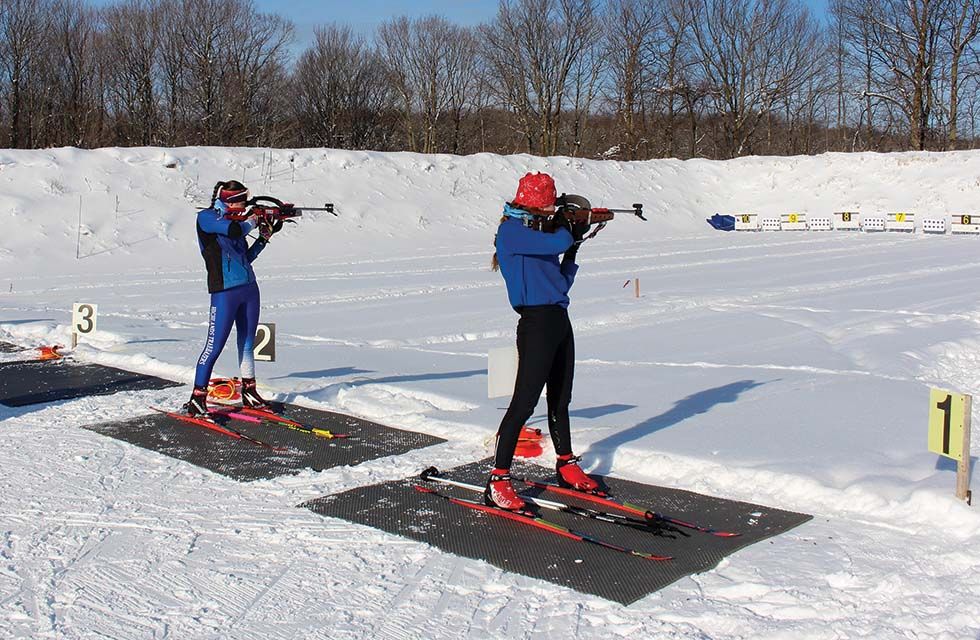
Annika and Kaija Guyon training at Highlands Nordic. Photo by Malcolm McCulloch.
On the opposite end of the age spectrum are up-and-coming biathletes like Trailblazers member Adrian Lang, who has been a biathlete for four years. This season will be his first year in the .22 program, and he’ll be racing in the Ontario and Quebec Cups, the Ontario Winter Games, and competing in Vermont against athletes from Canada and the U.S.
“I started biathlon because, while at Highlands Nordic, I had seen the biathletes practicing and I thought it looked cool,” Lang says. He cites focus, physical fitness, and attention to detail (specifically for body position, shooting process, and ski technique) as some of the values he takes from the sport. Another benefit? “The great coaches I have who are lots of fun,” he says.
Finding qualified coaches is an ongoing challenge, says Kraus. “It’s not one of those sports where most parents can volunteer to coach. We have parents with enough ski knowledge, but those people also need to have experience in shooting.”
As enrolment in the sport in Ontario rises, though, so does the talent. Malcolm McCulloch, 19 years old, began in biathlon a decade ago at Highlands Nordic and is now on Canada’s junior national team, competing at the international level. “Biathlon has given me a really great and supportive community and helped me learn high-performance habits. I’ve had the opportunity to travel the world and meet some incredible people. I get to spend my whole year doing what I love and learning about myself,” says the Collingwood Collegiate Institute grad thoughtfully.
Asked why he thinks more people haven’t gravitated to biathlon, given its merits, McCulloch says, “I think the difficulty of the sport and the fact that you’ve got both shooting and crosscountry skiing in the same sport.”
In that way, the name biathlon is somewhat of a misnomer. It’s truly one sport, with opposing skill sets required to do it well. But to obfuscate things further, it also requires a singular mindset to execute those skill sets. At its core, biathlon is about mind mastery. Winning or losing is judged on the shooting range, but that outcome is dictated by the biathlete’s ability to block out their opponents, time, physiological sensations and needs, and the scurry of their own thoughts while skiing and shooting. In every biathlon, the biathlete must give themself licence to be still. Enjoying a martini afterwards is entirely optional. E
For more information on biathlon in Ontario, Grey, Bruce, and Simcoe, visit:
Biathlon Ontario (biathlonontario.ca/wp/)
Midland Snow Dogs (ski.mountainviewmidland.com)
Biathlon Bears, Hardwood Ski and Bike (hardwoodskiandbike.ca)
Highlands Trailblazers Biathlon Club (highlandstrailblazers.ca)