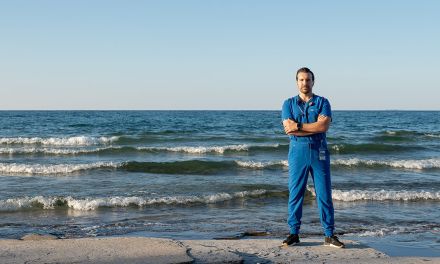

Photo by Catherine Tolton.
Light Over Huron
By John Matlock
The enduring humanity of Chantry Island Lighthouse.
On a warm summer afternoon, the first thing visitors notice when climbing aboard Peerless II is often the coolness—that unmistakable breath of Lake Huron air rising from the surrounding water, fresh and invigorating even on the hottest day. As the tour boat leaves Southampton harbour in the Town of Saugeen Shores, passengers follow a route shaped by generations of sailors, fishers, and merchant vessels at this oldest port on the Bruce County coast. Just a kilometre offshore, Chantry Island Lighthouse stands bright against the sky—white limestone and a red lantern roof rising above the lake.
It’s a calm day, and the captain slows over a narrow opening known simply as The Gap. Guests lean over the rails and peer down into the water. In subtle, shimmering light below lie remnants of the old Long Dock cribbing—weathered timbers that once formed part of Southampton’s Harbour of Refuge—and, nearby, the submerged remains of the Erie Stewart, one of two schooners claimed by storm and darkness in a single terrible night in 1907. History here is not only remembered—it rests just beneath the keel.
Ten minutes later, visitors arrive at Chantry, and now history towers above. For more than 165 years, the lighthouse has stood watch over this coast—through storm, fog, and ice—for good reason. In the nineteenth century, the Great Lakes were highways—alive with tall wooden sailing ships under full canvas, steamers pushing north and south, and hardworking crews moving grain, timber, coal, fish, mail, and people seeking new lives.
Their sails once filled this horizon, and travel between communities was often easier by water than by road. But these were unforgiving routes. Sudden squalls and hidden shoals could turn passage into peril.
On the edge of Southampton, as vessels were wrecked, grounded, or lost to the lake, a more sophisticated marine hub took shape—with a storm signal tower warning captains, a lifesaving station ready to respond, range lights guiding vessels toward safety, and the Long Dock extending into the lake to help create a protected Harbour of Refuge. Offshore, Chantry Lighthouse stood as the anchor of that system—its beam visible across the inland sea. Local lore held that the oil-fired flame, magnified through the great Fresnel lens, could be seen astonishing distances along the Bruce coast—perhaps even as far north as Tobermory by sailors high in the rigging on clear nights.
Chantry was built for purpose, not romance. It was completed in 1859 as one of Lake Huron’s six Imperial Towers. Stone was quarried near Inverhuron and hauled across open water by schooner and barge—a difficult and sometimes dangerous undertaking. Supply boats were lost. Costs climbed. Builder John Brown, a Scottish stonemason, nearly went bankrupt completing the work. Yet what emerged was extraordinary—an 86-foot-tall white dolomite limestone structure, with walls seven feet thick at the base, crowned by the great French-crafted lens that once cast its beam far across the inland sea.
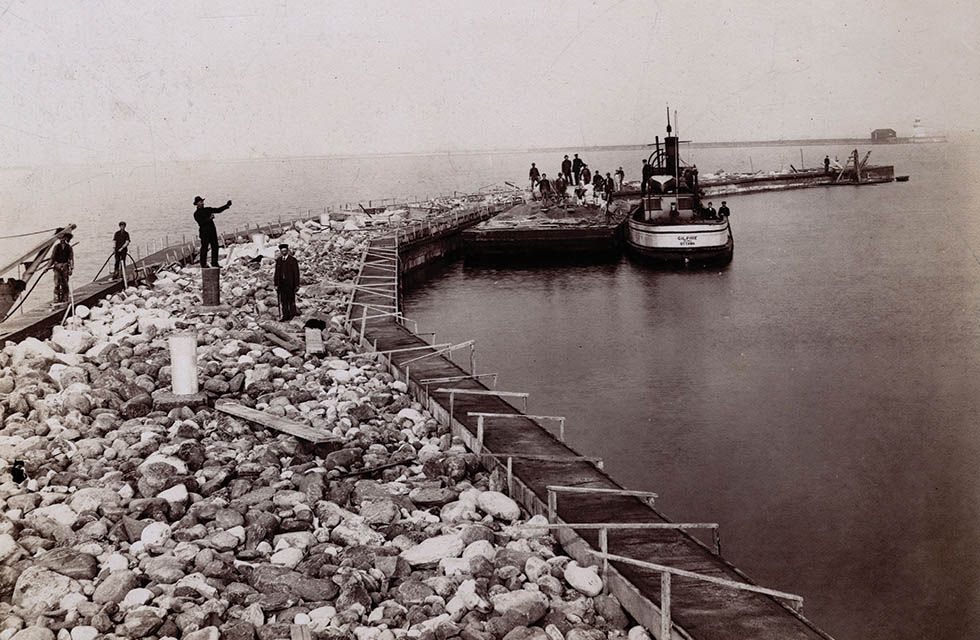
Construction of Short Dock, Southampton (late 1870s or early 1880s). Photo courtesy of Bruce County Museum & Cultural Centre.
But stone and light alone do not explain Chantry’s enduring hold. That story begins with the people who made a small island in Lake Huron their world.
The first was lighthouse lamp keeper Duncan McGregor Lambert, who arrived with his wife Louisa and, over time, raised a large family. Life on Chantry demanded constant physical work. Beyond hauling oil up 107 steps and maintaining the lens, there was a household to sustain. Gardens were planted. Fruit trees tended. Chickens were kept, a cow supplied milk, and fish from the surrounding lake supplemented provisions brought from the mainland. The Keeper’s Home, beside the tower, was not merely shelter—it was the centre of daily life.
Within those limestone walls, Louisa Lambert was as essential to the operation as any keeper in the tower. She managed the household, taught her children at the kitchen table, mended clothing, prepared meals, and ensured the family could thrive in a remote and demanding place.
Self-reliance was constantly put to the test. One of Louisa’s eleven children was born on the island in winter, without a doctor or midwife—a reminder of how far removed Chantry could be from help on the mainland.
There was hardship, but also family and routine. Children explored the shoreline and wooded paths. Boats occasionally arrived with curious visitors. Duncan and Louisa’s son William would later offer tours for ten cents—an early glimpse of the island’s future.
And through it all ran a constant thread of duty—to keep ships off the shoals and mariners safe. The lake could turn quickly, and the work was unrelenting: keeping the lamp room lit, clearing condensation and ice from its windows, firing a warning cannon in fog, and maintaining watch through storms. At times, it meant rowing into frigid, dangerous water to rescue sailors—or recover those the lake had claimed.
This was Chantry—a place where children were raised, bread was baked, lives were saved, and lives were lost; both a home for families and a refuge for mariners. Then, gradually, it became a ruin.
By the mid-twentieth century, the keeper’s era had come to an end. Electricity kept the light on—no keeper, no homestead needed.
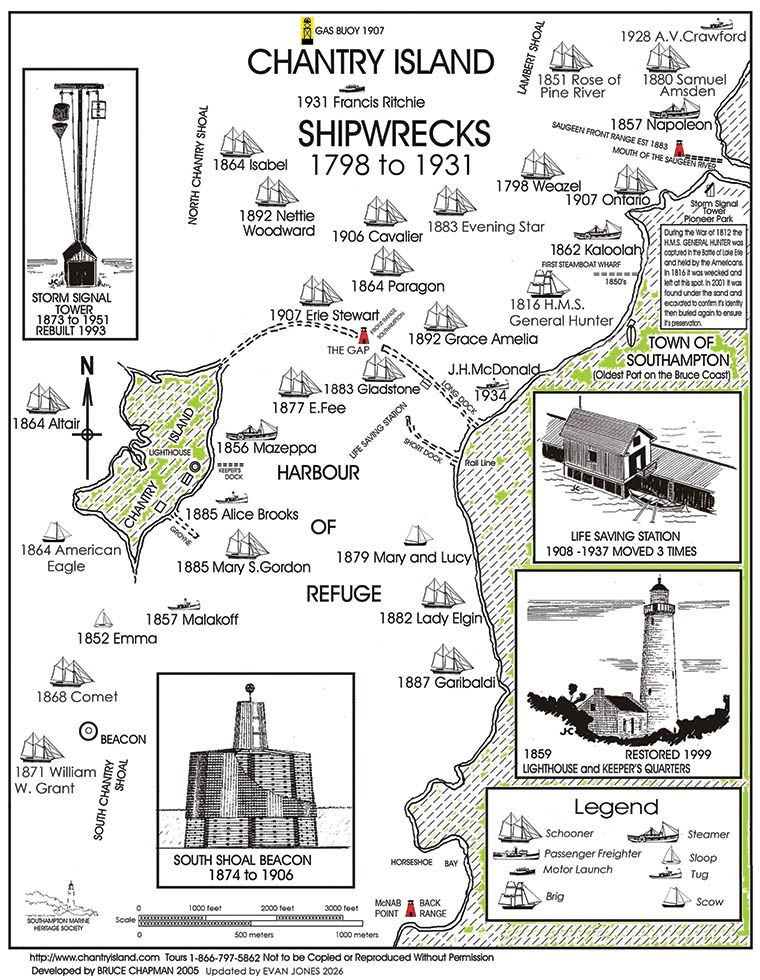
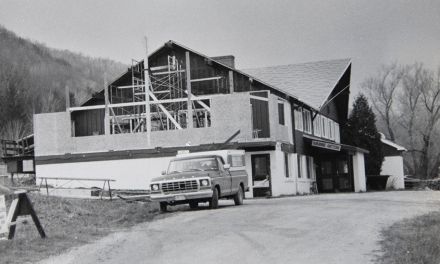
Left: Map developed by Bruce Champman 2004, updated by Evan Jones
2026. Right: Margaret and George Gruetzner rebuilding the Keeper’s
Home. Photo courtesy of Bruce County Museum & Cultural Centre.
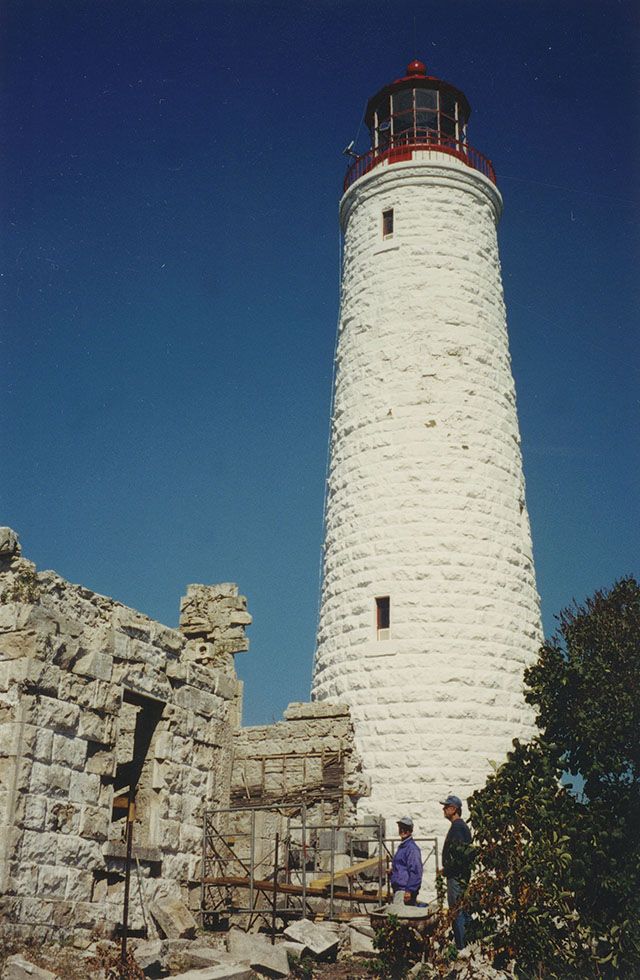
Lake Huron weather and time took their toll. Roofs failed. Floors gave way. Stone walls of the Keeper’s Home fell inward, some tumbling into the basement below. What had once been a complete lighthouse family compound seemed destined to fade.
Then, in the 1990s, a different kind of keeper arrived. A group of local volunteers looked across the water and saw not what Chantry had become, but what it could be again.
At the centre was Mike Sterling—practical, determined, and deeply hands-on—a person as comfortable planning restoration as carrying it out. Each week, he gathered with a few others over a beer at the Walker House—a historic pub older than the lighthouse itself—to work through challenges and find solutions. They called themselves the Propeller Club. Around that small table grew a wider team—carpenters, tradespeople, boaters, retirees, and neighbours willing to contribute what they could. They became the Marine Heritage Society—a new generation of keepers, preserving memory.
The work was extensive. Permissions were secured. Partnerships were built. Materials were moved across water. Heavy timbers were cut, milled, hauled, and raised. Masonry was repaired. Interiors were painstakingly rebuilt room by room, detail by detail. Gardens replanted. Outbuildings and walkways restored.
And alongside the work, funding steadily followed— mostly from countless small, private donations, fish fry dinners, and even a concert by Canadian folk singer-songwriter Valdy. As word of the project spread, more than 250 volunteers contributed upwards of 22,000 hours of labour—an extraordinary act of community stewardship that helped bring Chantry back to life.
What some visitors encounter today might feel dreamlike. They arrive on the gentle bob of the tour boat, step onto a floating dock still rising and falling with the water, then move along the jetty and fixed walkways before following a stone-lined path curving through trees and into full view of the 1859 structures—a passage, however brief, into another time.
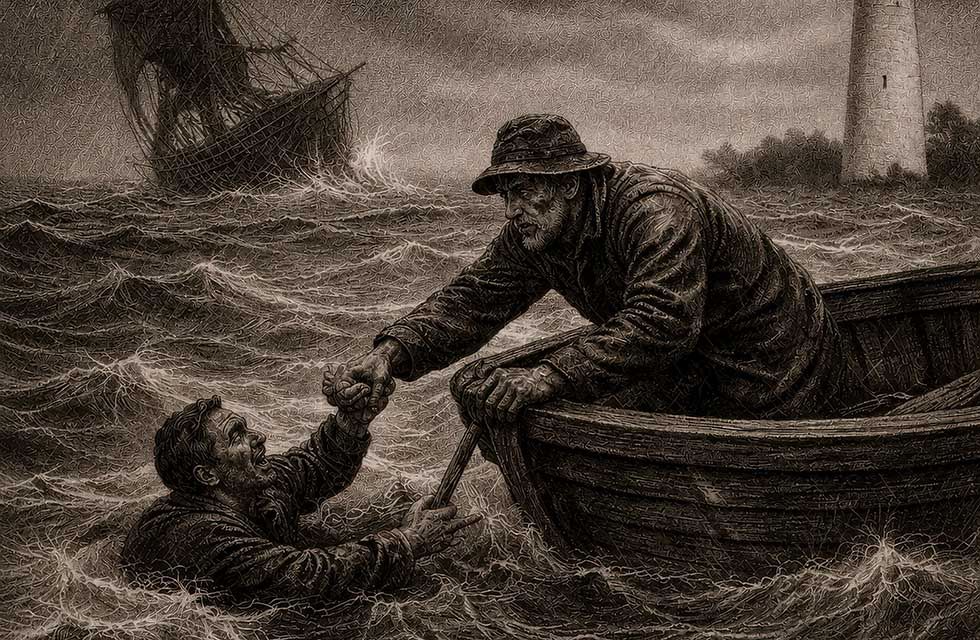
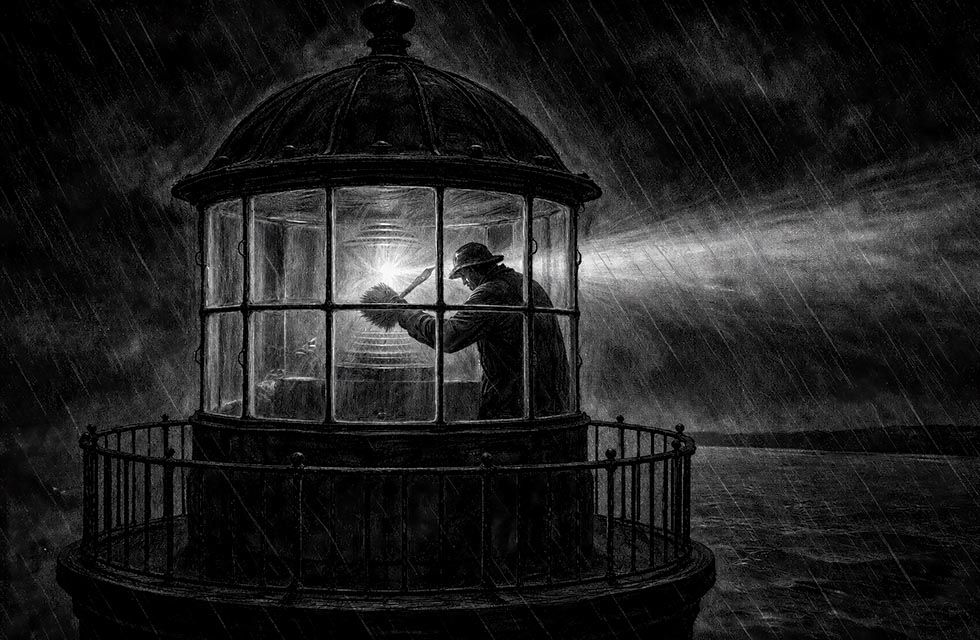
Sketches by John Matlock.
And then there is the sound. Not the silence of solitude. As a protected migratory bird sanctuary since 1957, the island fills each spring with tens of thousands of nesting birds—herons, egrets, gulls, and cormorants. Their calls fill the air, a reminder that this is not only a historic site, but a living and loud one.
Then comes a surprise. Visitors expect a lighthouse and keeper’s home—but not one so complete it feels as though an 1800s family has only just stepped outside. Furnishings, pictures, quilts, cooking tools, toys, corded bedsteads, and even a table set for a meal all add to the texture of life once lived here.
Onto the ascent, at the base of the great stone tower, a guide, with diagrams in hand, explains its construction and the elegant engineering of the French-made lens. Entering the tower’s dim lower chamber, visitors pause as their eyes adjust and notice an unexpected link to the past—the smell of lamp oils once stored here, still faintly held in the old brick.
The stair pitch is steeper than a modern staircase, the passage narrower, handrails close at either side. Level by level, visitors rise single-file through stone and timber, pausing at landings where the guide shares photographs and details of the craftsmanship and maritime duty that unfolded here.
Near the top, wood gives way to iron and brass—the pedestal room, with a central column rising to where the lens once stood. Then one final climb—up a steep, bright red stair of French ironwork, almost ladder-like—and suddenly your head emerges through a hatch into full daylight.
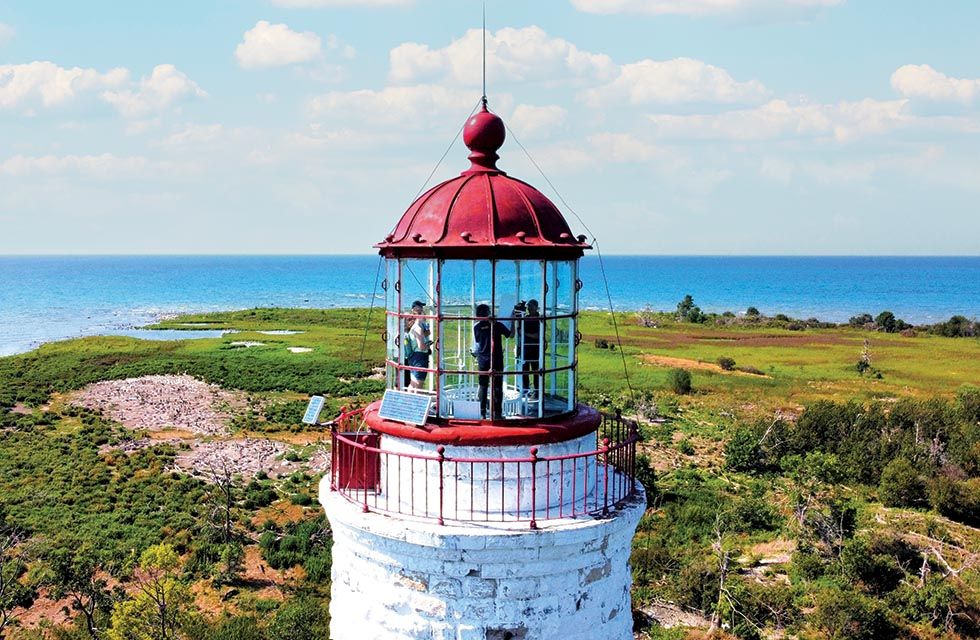
Photo by Catherine Tolton.
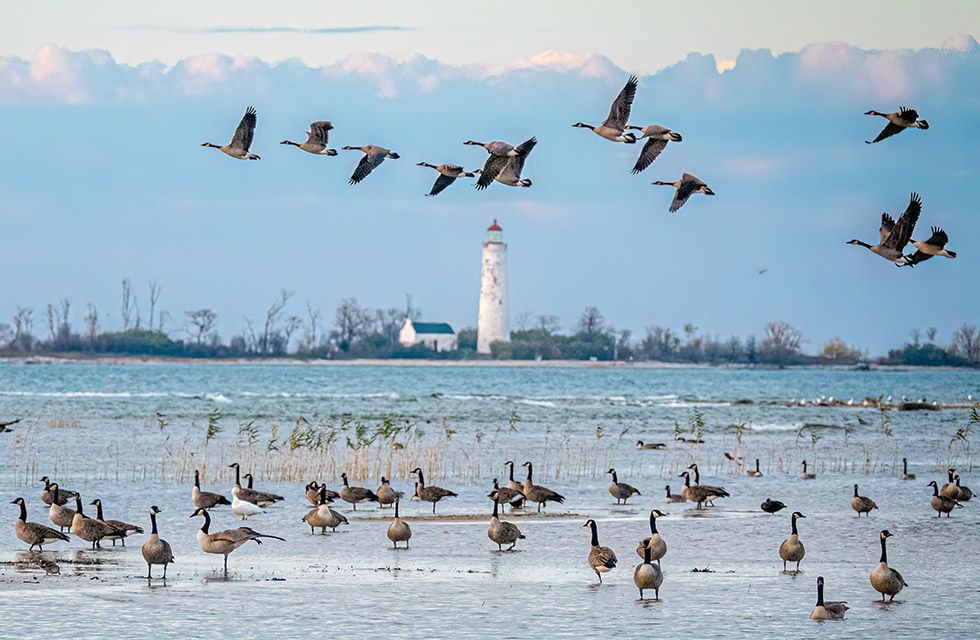
Photo by Catherine Tolton.
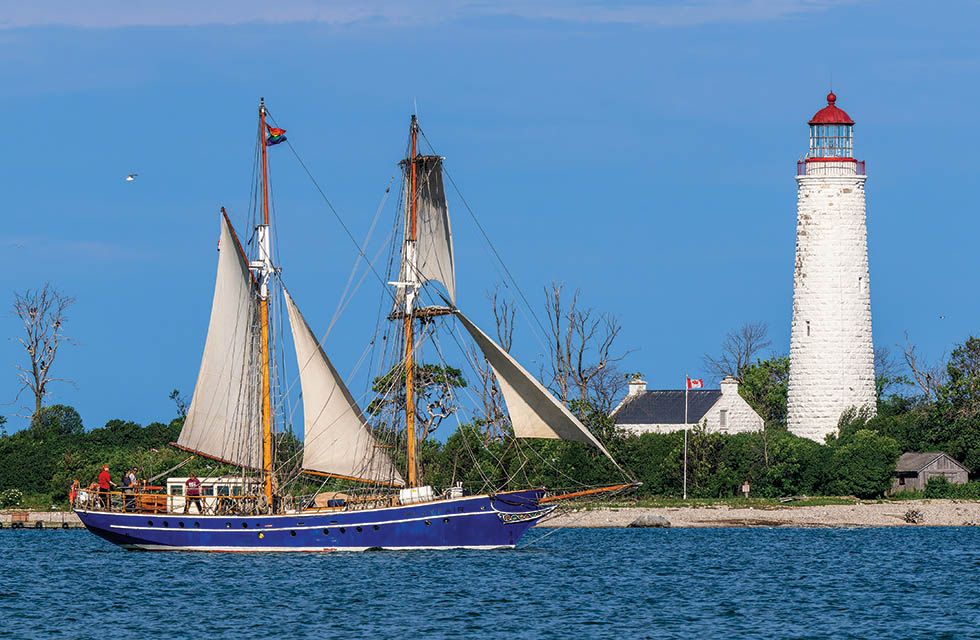
Photo by Pat Gillies.
“What we’re trying to leave for the future is some part of our humanity. We’re leaving this structure as part of our heritage—telling those who come after that we were here, that we were human just like them, and that we left something better than we found it.” —Mike Sterling (1999)
Floor-to-ceiling glass surrounds you. Other than slender frames holding the panes in place, there is nothing between you and Lake Huron’s vast blue sweep. Far below, Chantry shrinks into miniature: thousands of nesting birds like scattered white flecks, winding footpaths as delicate lines, and the Peerless II bobbing like a silver toy by the shore. The old Long Dock stretches toward Southampton as a faint brown curve beneath the water, leading the eye to sandy beaches, cottage rooftops, and the giant Canadian flag at the foot of High Street.
It is a breathtaking outward view, and at times, an inward reflection. Chantry is, in many ways, about perspective.
For the keeper families, it was a place of responsibility. For sailors, reassurance. For volunteers, enduring commitment.
And now, for some visitors at the top, perhaps a moment to consider their own place within this landscape—and the light they now carry into the world.
The journey continues at chantryisland.com, and each Wednesday at Southampton’s Walker House, where all are welcome. E