Duntroon Highlands Resort
A Dill of a Game
By Cara Williams | Photography by Alan Shisko
A paddle, a plastic ball and a deceptively addictive game are reshaping recreation—and bringing generations together—across Southern Georgian Bay.
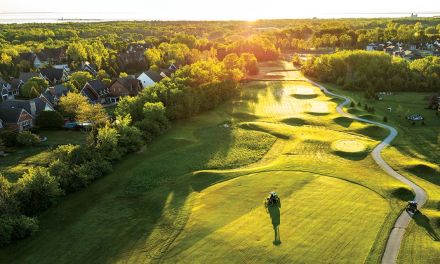
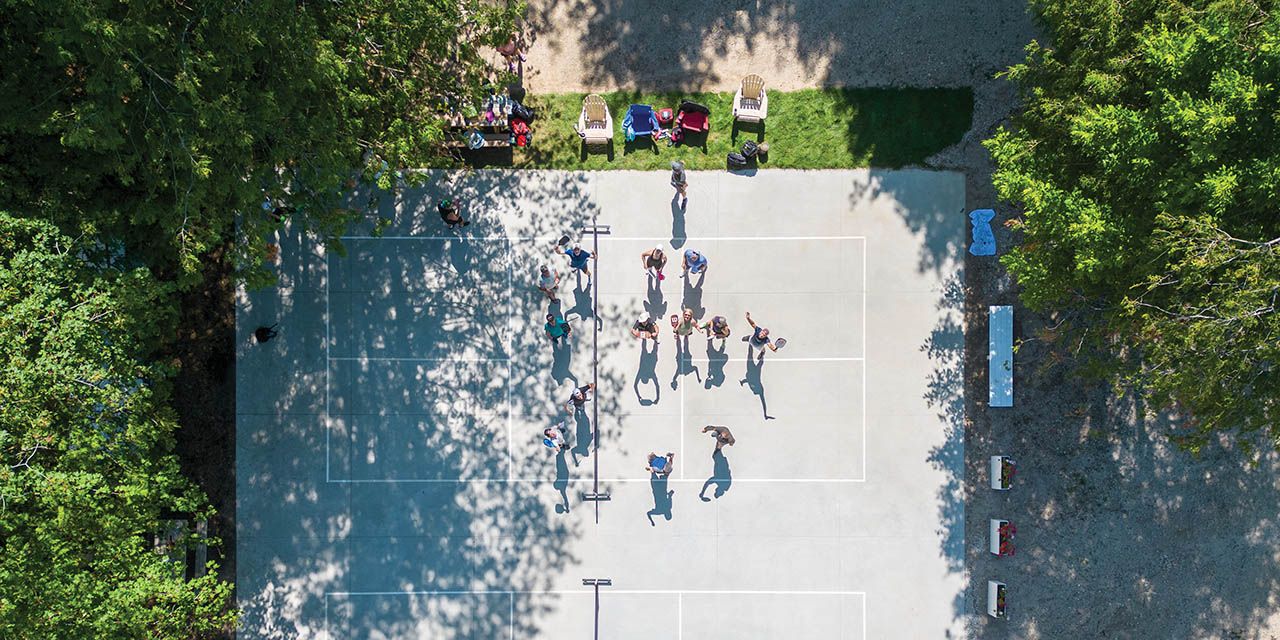
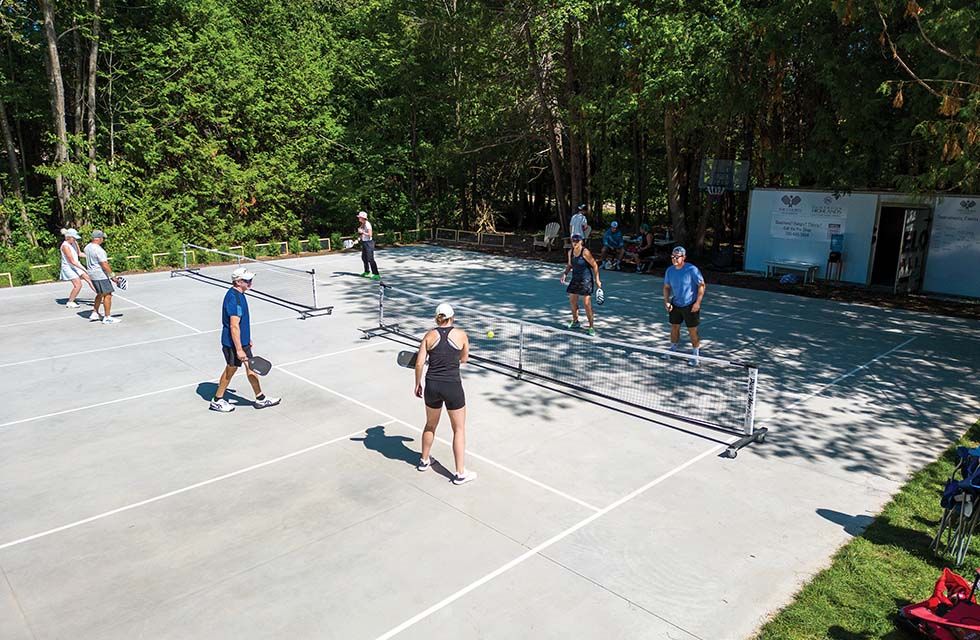
At The Courts at Duntroon, pickleball doesn’t announce itself in neon blues or tournament banners. The colour palette is muted—soft greens and earth tones that settle easily into the surrounding landscape. Wind moves through the cedars. Then comes the sound: the distinctive pop of paddle meeting ball, crisp against the quiet. Between rallies, laughter drifts across the courts.
“We wanted something that fit the setting,” says Stacie Smith, Director of Operations for Duntroon Highlands Resort. “A place where people could learn the game, play with friends and just enjoy being out here.”
Four years ago, after falling in love with pickleball, Stacie began imagining something different for Duntroon Highlands. Not a high-intensity complex nor a hyper-competitive arena. But a place where players could learn the game without intimidation, book a court with friends and linger long after the final point.
The result is intimate by design. Two courts. Membership capped at 100 (at the time of writing, there are a few available). If the golf course is open, the courts are open. No scramble for time slots. No anxiety over waitlists—just a social club that feels perfectly at home in this landscape.
Pickleball itself has similarly unassuming beginnings. Invented in 1965 on Bainbridge Island, Washington, the game was improvised in a backyard with ping-pong paddles, a perforated plastic ball and a lowered badminton net. The origin of its name is still debated—some attribute it to the family dog, Pickles; others to the “pickle boat” in rowing, where leftover oarsmen are assembled into one crew. Either way, the sport began as something accessible, adaptable and communal.
Smash Pickleball Collingwood
Those qualities remain central to its appeal.
For a while, the demographic leaned older—former tennis and squash players, Gen Xers and boomers looking for a second act in racquet sports. But something has shifted. High school students now rotate through. Families book courts together. What began as a retiree pastime is steadily attracting a broader mix of players.
For many players, the real draw has less to do with perfect technique and more to do with the easy camaraderie that forms between points. Kerry Baker discovered the sport a few winters ago, while looking for something active—and social—to carry her through the colder months. A mother of two teenagers, she and a group of friends decided to give pickleball a try at Charge Pickleball located in the former Georgian Bay Secondary School facility in Meaford.
“It was a friend from work who wanted to try it,” Kerry says. “We thought, okay—let’s just do it.” The experiment stuck. What began as a winter diversion carried through spring, summer and fall, eventually moving outdoors to the courts at the Georgian Peaks Summer Club where wind, weather and different surfaces add a new wrinkle to the game.
Kerry’s group now plays regularly under a self-appointed team name that captures the spirit of their approach: Pickled and Confused. Even the teenagers join in from time to time. “If we’re on a court with really serious players, we try to behave,” Kerry laughs. “But if it’s just us or other like-minded people, we’ve got music playing, someone might bring a beer, and there’s usually some dancing happening between points.”
Unserious, perhaps—but far from lazy. “It’s actually a really good workout,” Kerry says. “You’re moving constantly.” What she appreciates most, though, is the sport’s accessibility. “I think that’s why it’s so fun,” she says. “It’s inclusive. You can show up as a beginner and pick it up pretty quickly, and it can be as competitive—or as social—as you want it to be.”
Duntroon Highlands Resort
You can show up as a beginner and pick it up pretty quickly, and it can be as competitive—or as social—as you want it to be.
The growth almost unfolded differently. Robert Naumovski and Bret Shepley were, at one point, preparing to open separate indoor pickleball clubs—essentially across the street from one another. Both saw the same opportunity. Both believed the sport was poised to surge locally. “You could feel it building,” Robert says. “People were curious about the sport, and once they tried it, they kept coming back.”
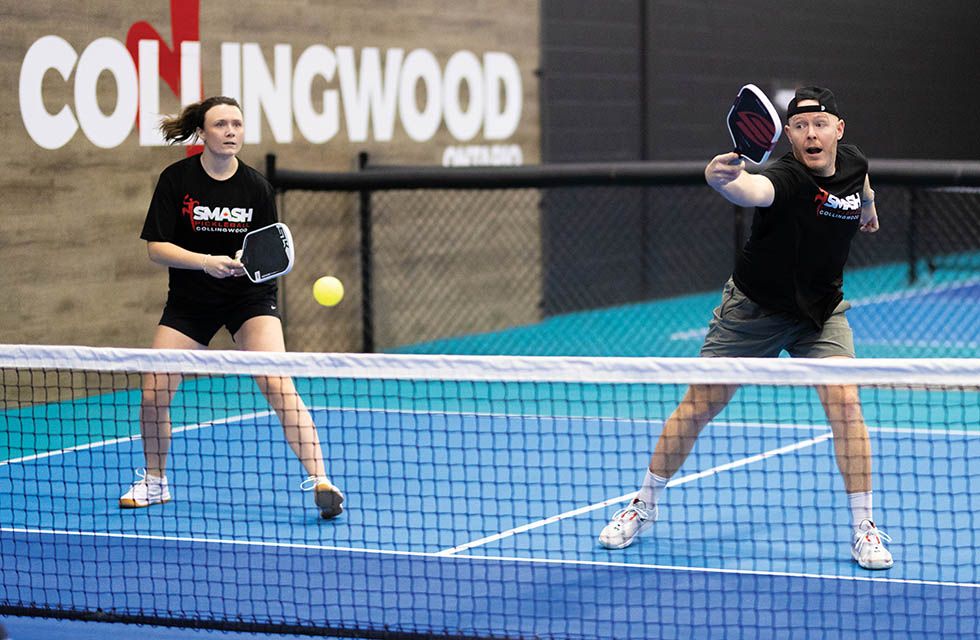
Rather than split the market, they chose to join forces and open Smash Pickleball—a franchise concept that arrived in Collingwood in September 2025. It was less about rivalry than readiness. Bret brings deep roots in the competitive scene—part-owner of a Canadian National Pickleball League team and connected to Team Canada’s development pipeline. Robert, an early adopter of the sport in the region and an operations-focused entrepreneur, brings structure and scale.
Together, they are building more than courts; they are building community. When memberships went on sale, it was raining. By 5 a.m., lawn chairs lined the entrance. Within forty minutes, the club was full. “We knew there was interest,” Robert says. “But seeing people lined up in the rain before sunrise— that told us something bigger was happening.” That image captures pickleball’s current moment—what was once dismissed as a recreational afterthought is now commanding real estate, investment and early-morning loyalty.
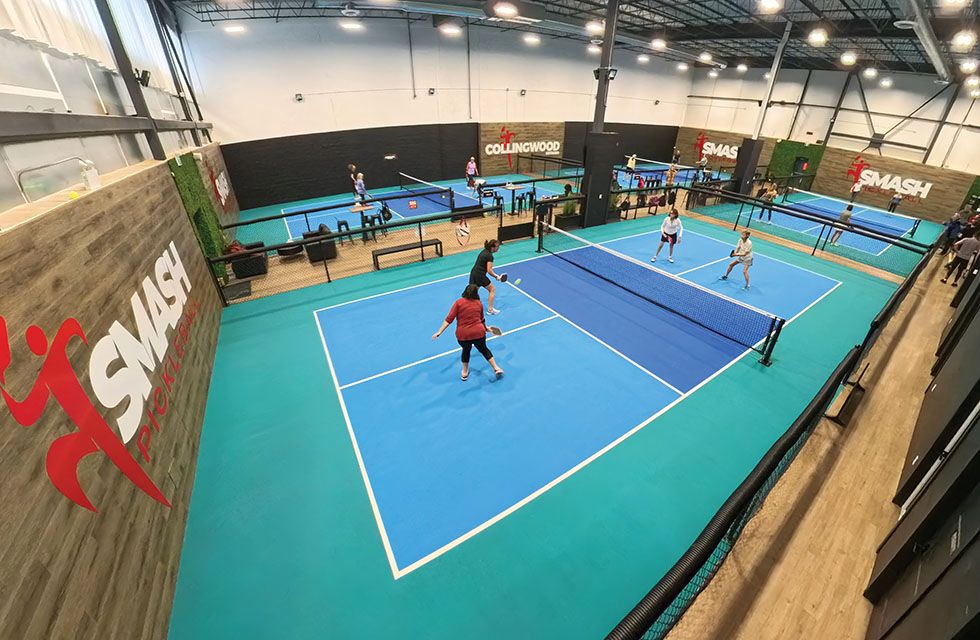
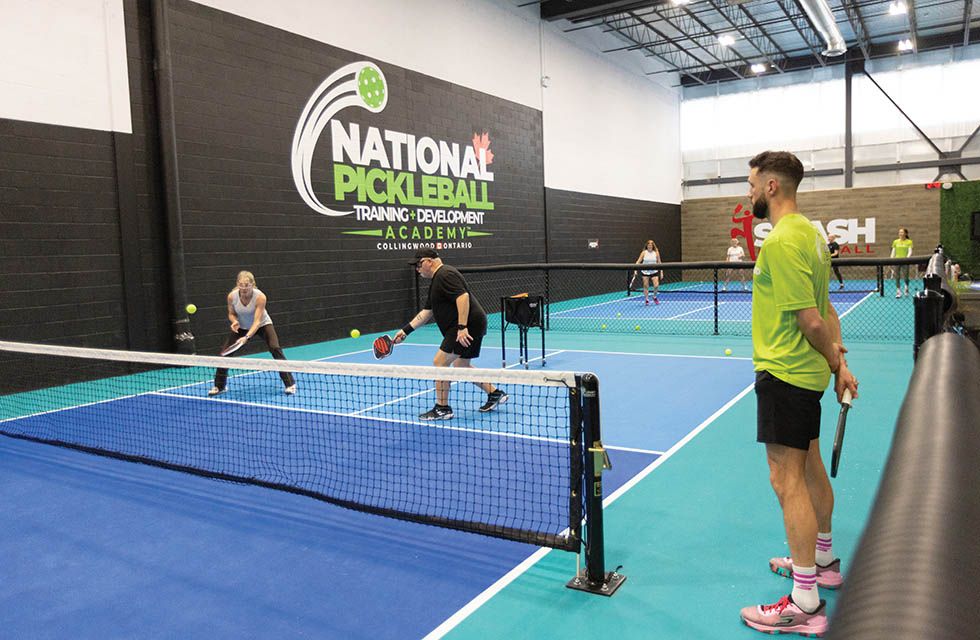
Smash Pickleball Collingwood
Today, the fastest-growing demographic is 18–34-year-olds, and younger kids are joining in. It’s not unusual to see three generations sharing a court—grandparent, parent, grandchild— playing together rather than spectating. Few sports allow that kind of overlap. Aside from skiing—perhaps cycling—the list is relatively short.
Municipalities across the region are responding. From Wasaga Beach and Collingwood to The Blue Mountains, Meaford, Wiarton and Flesherton, courts are appearing as quickly as lines can be painted. Platforms such as Pickleheads.com now help players locate nearby courts, clubs and programming, whether they’re new to the sport or simply new to town.
And yet the appeal remains simple: step on a court and you’re in. No prohibitive cost. No long learning curve. Just movement, momentum and the enjoyment of the game.
The pop of paddle on ball now carries across the Escarpment. It threads through shoulder seasons and spills into spring evenings. On some courts the rallies are serious; on others, the music is up and the players might look a little more like Kerry’s Pickled and Confused crew.
And in a region shaped by movement—skis carving winter slopes, bikes tracing backroads, boots climbing the Escarpment—pickleball has found its place. E