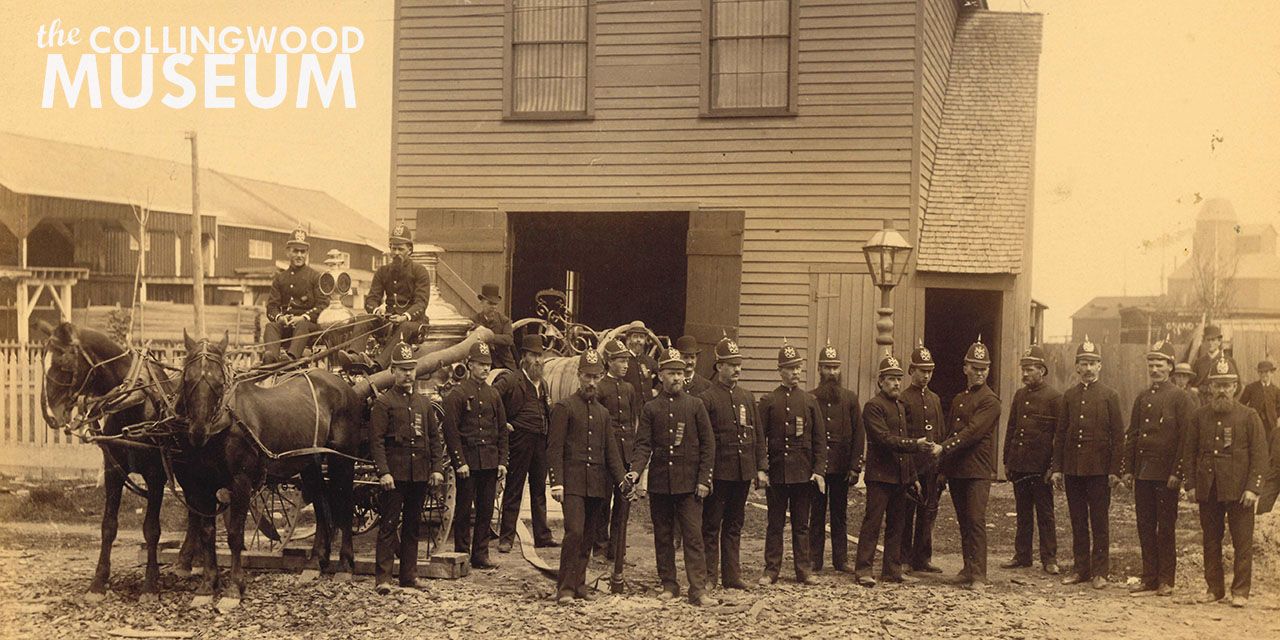
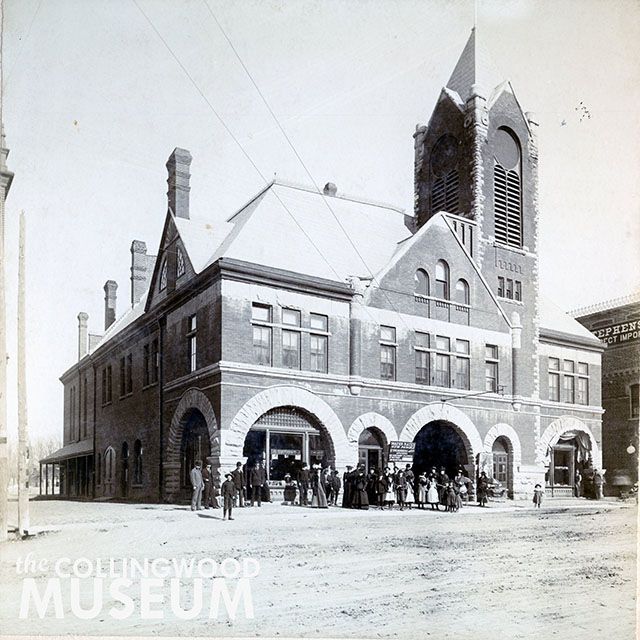
The Georgian Fire Co. outside Collingwood’s original town hall, May 24, 1888—just over a year before the building was lost to fire. Photograph by C.A. Fanjoy. Collingwood Museum Collection, X970.498.1
A Day of Tall Work and Many Tears
Script by Ken Maher | Stories from Another Day, a Collingwood Museum Podcast.
Photos courtesy of the Collingwood Museum.
A civic holiday in Collingwood turned to disaster in 1890 when a fierce fire swept through town, destroying the newly opened Town Hall and the community’s early history.
The cool breeze and the sound of gulls were interrupted by a man’s voice carrying over the deck. “Apparently the good people of Collingwood don’t know that it is a holiday. See their tall chimneys doing tall work!”
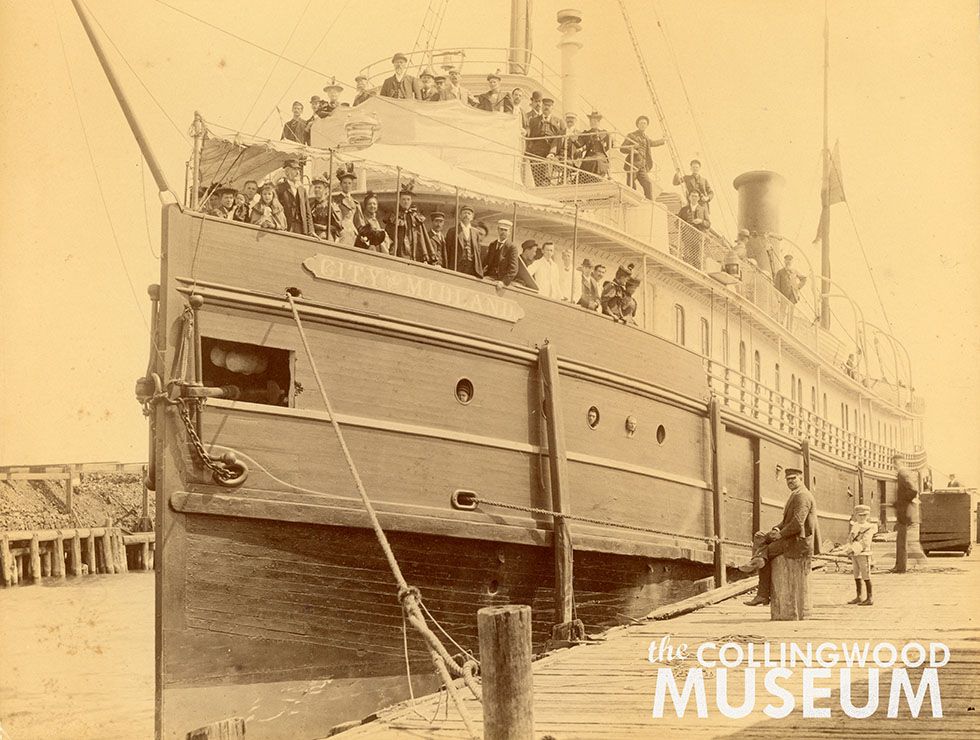
Those within earshot looked up to see heavy clouds of smoke in the distance. A goodly chuckle rippled across the steamer decks. But as the City of Midland came closer into Collingwood, unease began to wash over the passengers like a rising wave. As the minutes ticked on, the smoke only grew thicker, darker, and more menacing. The unease among those clustered at the ship’s rails turned to alarm. A fire was raging in the heart of Collingwood.
The day was August 13, 1890, and the stranger’s joking words would prove to be sadly prophetic. It would indeed be a day for tall work. And a day for many tears.
Several of the passengers who watched with growing panic were residents of Collingwood returning home after having spent their holiday out on the bay. Were their homes and businesses in danger? Were they already in ruin? What would await them when they pulled up to the dock?
The panic beginning to rise in the hearts and stomachs of many was even more understandable if you know that they had already been through this very same nightmare when the downtown had been destroyed by a conflagration… well, that is an equally sad story for another day.
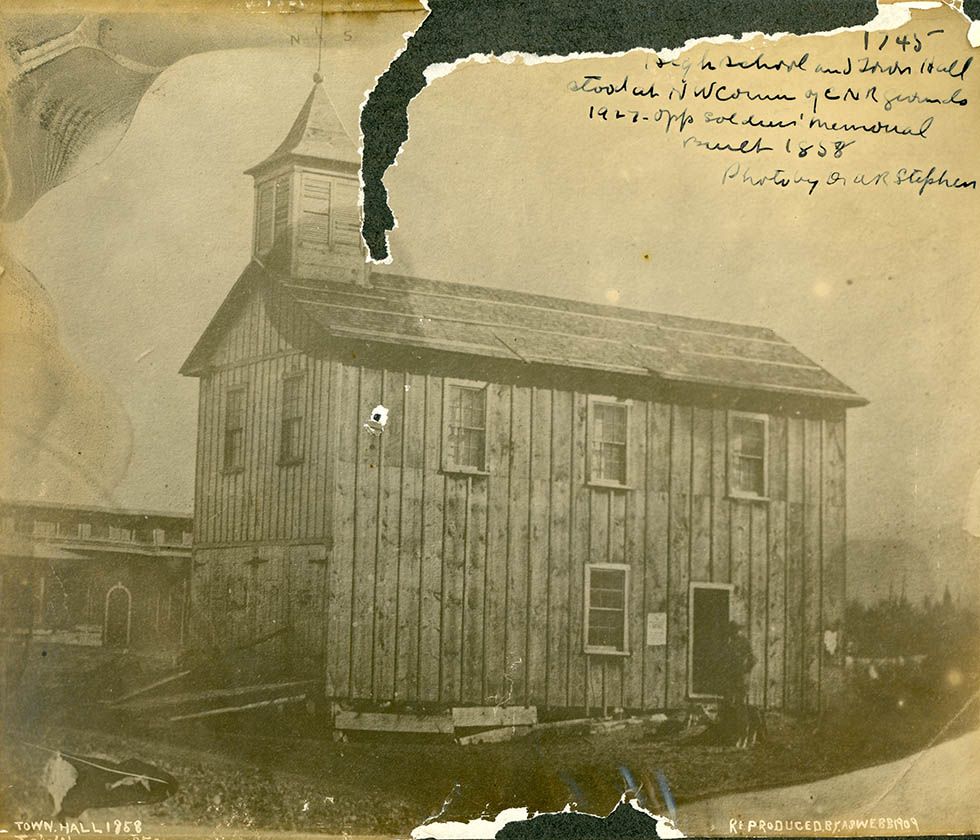
Left: Collingwood’s first town hall, photographed by Dr. A.R. Stephen, from a series documenting early scenes later donated to the Huron Institute. Collingwood Museum Collection, X970.876.1; Huron Institute Collection No. 1745.
Right: The steamer City of Midland, built in Owen Sound in 1890, burned in Collingwood’s harbour on March 17, 1916. Collingwood Museum Collection, X974.838.1.
On this day, when the City of Midland and her passengers finally got into the harbour, the news was grim indeed. The new Town Hall, only just opened to the public weeks before, was ruined. The old hall was destroyed. Several smaller buildings—both houses and businesses—had already been levelled to the ground, and the Grand Central Hotel’s barns were no more.
So, what happened?
At 3:45 in the afternoon, the fire alarm had gone up. It seems that a fire had begun in the Old Market Building and was already well underway. Because it was a holiday, the town’s firemen were in the Town Park along with nearly all the townspeople. Everyone was enjoying the program arranged for the day.
The alarm brought the fire brigade in great haste, along with many of the townsfolk. The waterworks were deployed with little delay. And this is where things began to go sideways.
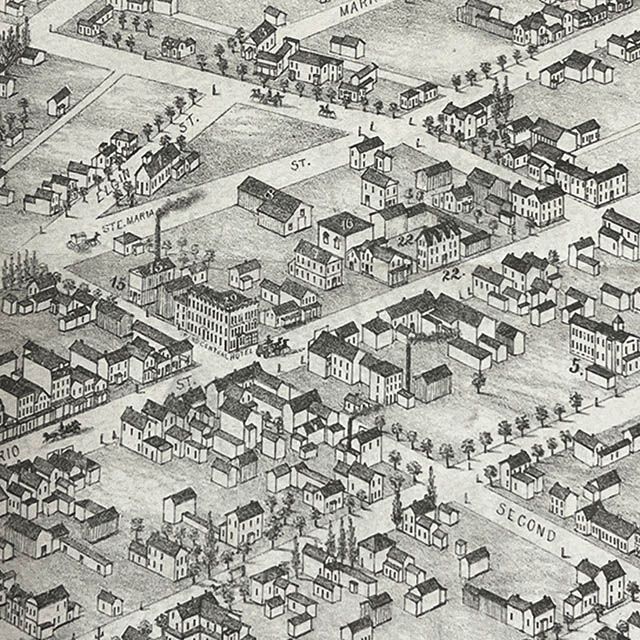
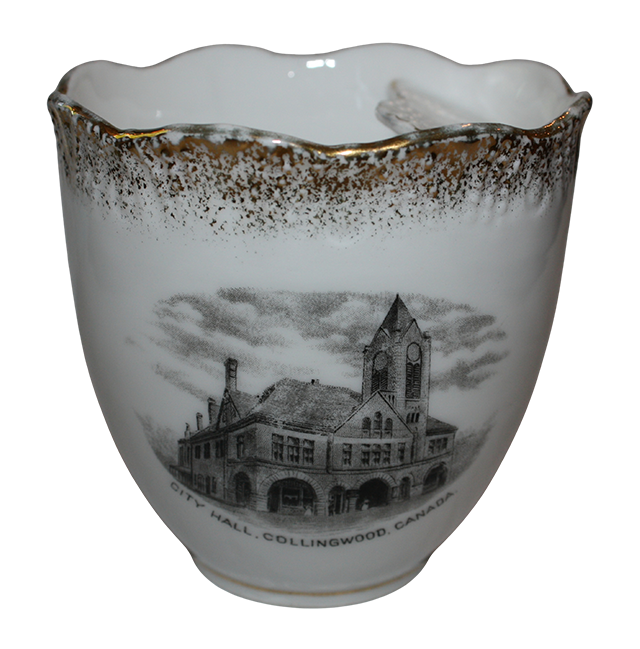
From left: An 1875 lithograph of Collingwood shows the only known depiction of the town’s second hall, a two-storey wooden structure between Hurontario and Ste. Marie Streets. Collingwood Museum submitted photograph. A decorative teacup featuring the current town hall, complete with a built-in mustache guard. Collingwood Museum Collection, X976.123.1a. The first brick town hall, where visible lime mortar washing over the brickwork points to early masonry concerns—believed to be the building destroyed by fire in August 1890. Photograph by James Asa Castor. Collingwood Museum Collection, 007.17.4.
As eyewitnesses tell it, for the first hour of fighting the flames, there simply wasn’t enough water pressure. Try as they might, the flames had the best of it. Even then, the heroic people of Collingwood—now joined by firefighters from Meaford and Orillia—may still have saved the day. That is until, without warning, the pressure became all at once too much and fully nine lengths of the fire hose split apart, utterly ruined.
With a heavy heart, the decision had to be made. Fire had already at this point taken hold of the roof of the New Town Hall, which couldn’t be reached, a the town’s pride and joy had to be given up to save lives and private property. While it was a bitter call to make, it did mean that a great deal of property was saved which otherwise might have been lost.
And to add one final insult to this day of injury—or perhaps as one final prophetic word to bracket this terrible day—as the smoke cleared and the damage was being assessed, what should be noticed right there adjacent to the burned-out ruins of the new Town Hall?
As the firemen packed up and the confusion died down, a banner strung up across Hurontario Street for the occasion of the civic holiday still remained proudly on display despite all the chaos. The banner had been hung there by the Collingwood firemen to announce a grand demonstration as part of the town’s program of events for that holiday. As fate would have it, this particular demonstration proved to be much taller work than even they had expected. E
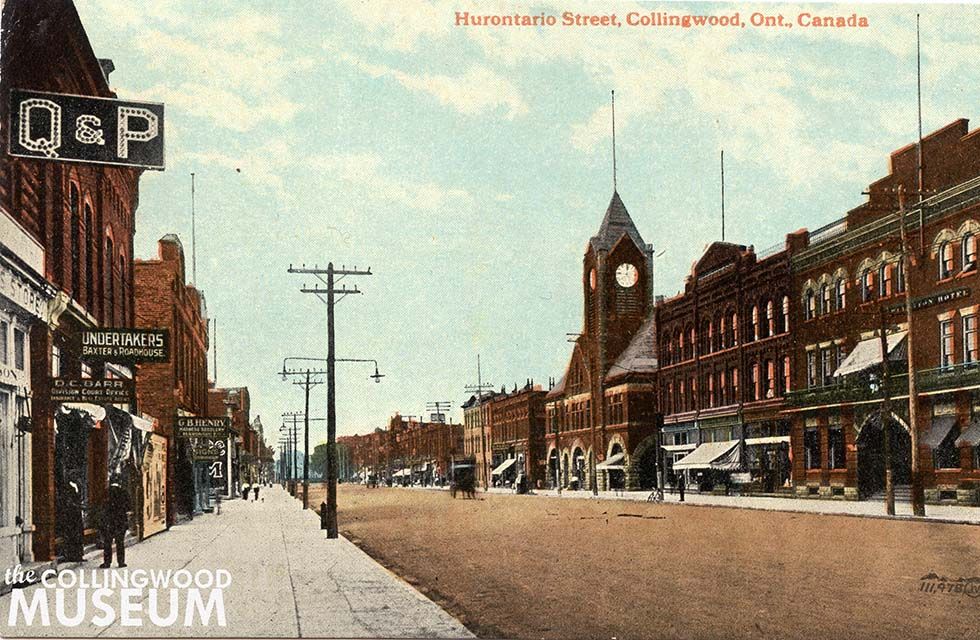
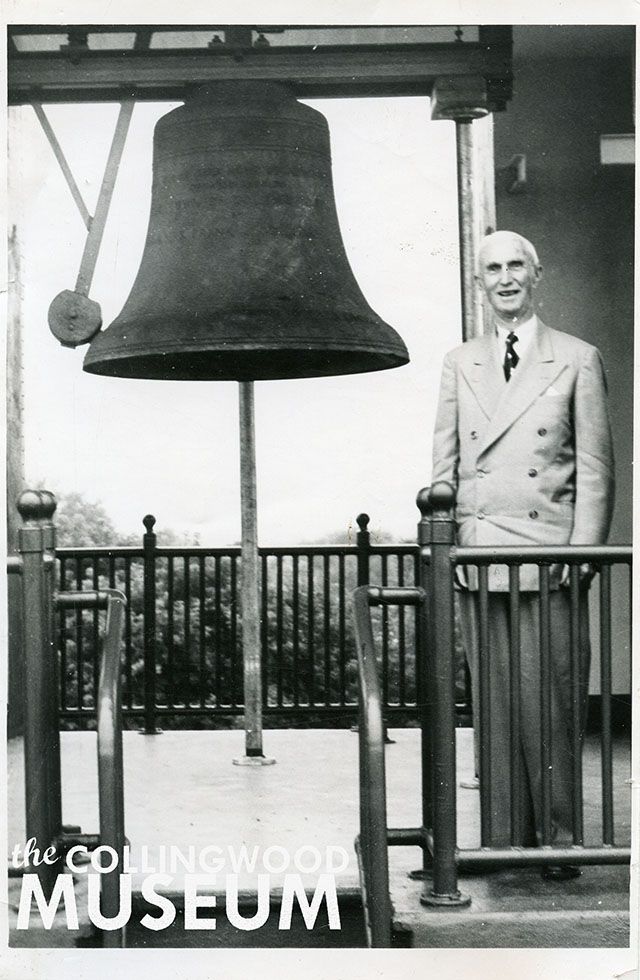
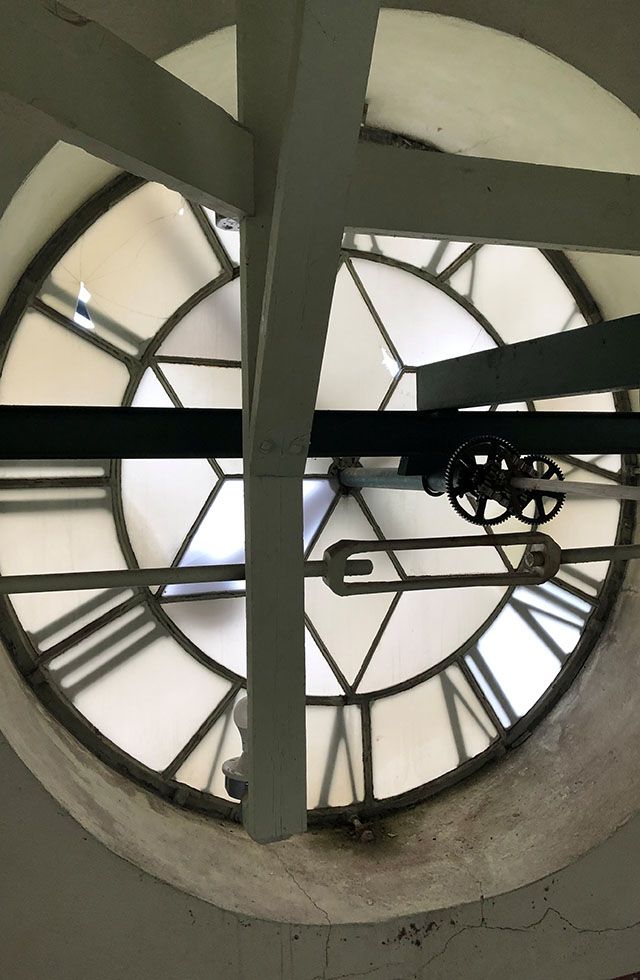
Clockwise from top: Early postcards often show a clock on the town hall tower—but Collingwood’s first and only clock wasn’t installed until 1951, a key detail used by Museum staff to date images. Collingwood Museum Collection, 002.73.1. Inside the clock tower, January 2020, revealing the inner gears. Collingwood Museum submitted photograph. Frank Courtice with the newly donated bell and clock, installed August 5, 1951—after the tower stood empty for 60 years. Collingwood Museum Collection, 002.35.11.