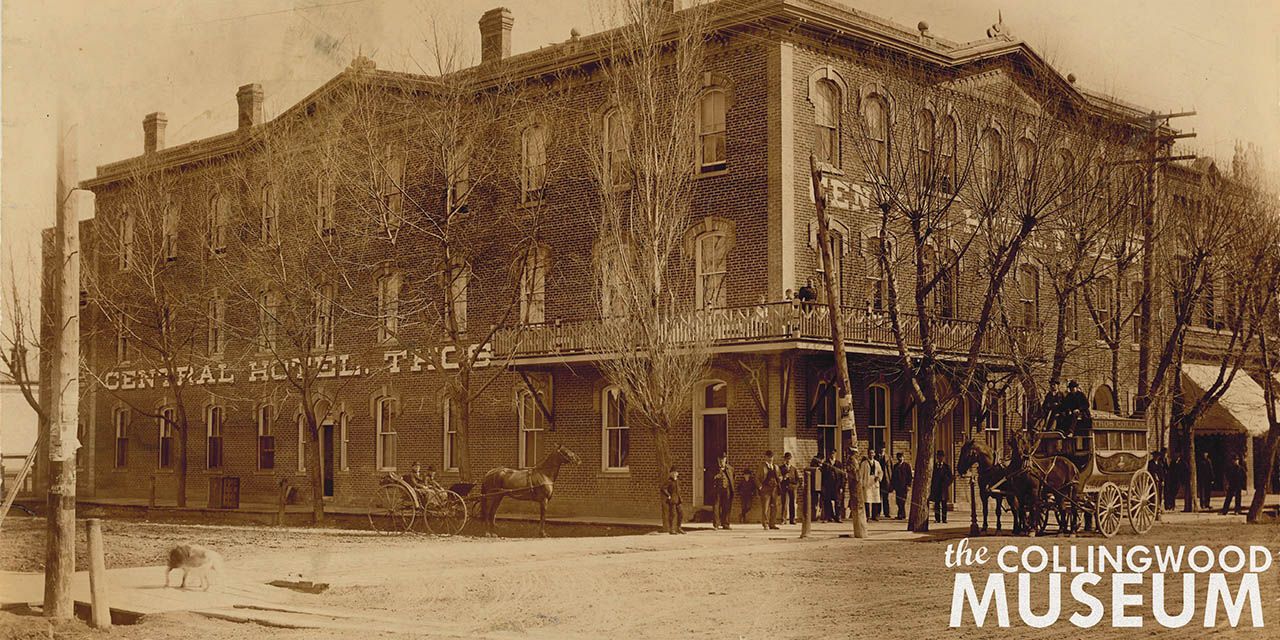
The Grand Central Hotel, an early Collingwood telephone subscriber, stood at the corner of Simcoe and Hurontario Streets. Collingwood Museum Collection, 2016.9.2.
Please Hold the Line
Script by Ken Maher | Stories from Another Day, a Collingwood Museum Podcast.
Photos courtesy of the Collingwood Museum.
In an era of party lines and limited service hours, Collingwood’s first telephone operators became the voices everyone relied upon.
“Collingwood switchboard, how may I help you?”
“Oh good, you are still there, Margaret! This is Mary, could you put me through to Dr. Stephen, please.”
“Do you have his number?”
“Number? Oh, right, we are doing that now. I forgot and I… I don’t have it here…” The woman’s voice was all of a dither.
Sensing the other’s disquiet, the calming voice on the other end of the line reassured her. “That’s just fine, Mary. I will put you through.”
After several moments that stretched on into an uncomfortable quiet, the operator came back on the line. “I’m sorry, Mary. There is no answer at the doctor’s residence and the switchboard is closing for the day.” There was a brief pause and then, “Is there something wrong?”
The question unleashed a flood of tears and words, both spilling freely. “It’s little William. He’s not eating or drinking. He has a fever and a rash, and he is crying and crying, and I don’t know what else to do!”
“Mary,” broke in the other woman’s compassionate but commanding voice. “Everything is going to be just fine. Here is what we will do. You send Doris over to the doctor’s home. She’s old enough to know where it is. I will stay here and keep trying to reach him. When I do, I will call you back to let you know.”
The tension left Mary’s voice. “Thank you, Margaret. Mr. Carpenter doesn’t pay you enough!”
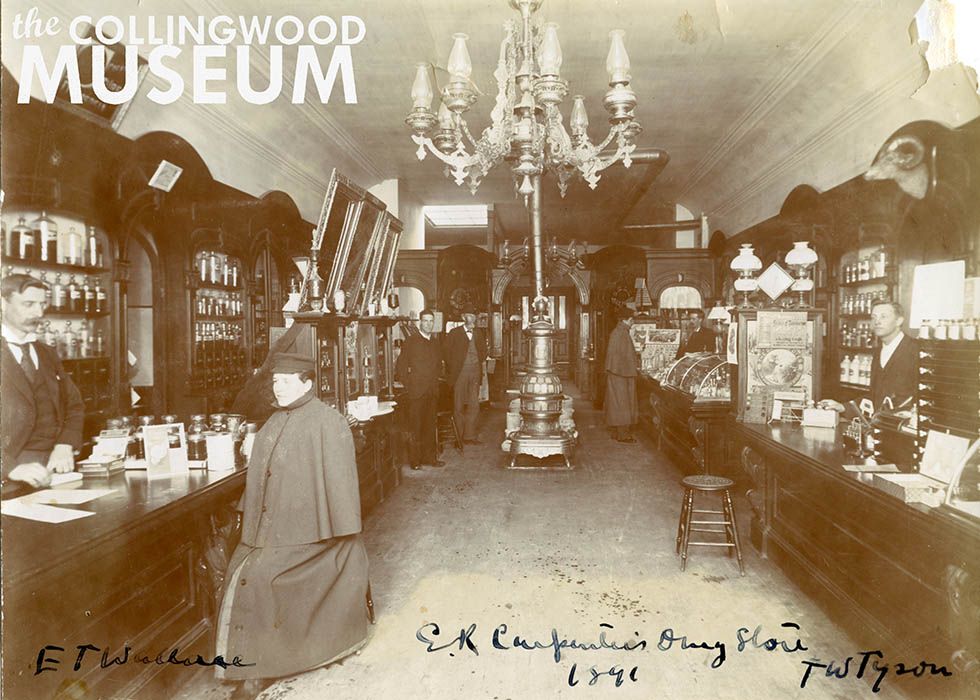
Interior of E.R. Carpenter’s Drug Store on Hurontario Street, where Collingwood’s first telephone switchboard was located. Collingwood Museum Collection, X968.898.1.
The telephone first came to Collingwood in 1886, less than 10 years after its invention. Edward R. Carpenter was appointed agent, and the switchboard was located in the rear of his drugstore. The fascinating Poetical Directory of Collingwood from 1875 describes his drugstore as follows:
His walls are transparent with glittering jars,
Like firmament lustre in flittering stars,
Abounds with three kingdoms in package and flask,
Barrels and boxes, jugs, bottle and cask;
Paints, dyestuffs, and varnish and essence in glass
The all-healing balsum [sic], sum total is mass,
All useful, all precious, all brought from afar,
On water by shipping, on land by the car.
Ales, porters and whiskeys and spirits of wine,
Pure rum, gin, and brandy and all in that line.
Keeps oils, the essencials [sic] of sweetest perfumes,
Stamped paper, most lovely and splendid for rooms,
Books, music and papers, and thousand things more,
He daily is selling in town, at his store;
Is also compounding in chemical skill
And the faculty riding acknowledge his skill.
I’m not sure that the Poetical Directory was ever updated, but if it had been modernized to include the telephone system, how might it have gone? A mysterious contraption, all-a-mess of bright wires, with deft hand and skill fulfills all your desires to speak across town while at home you retire!
An interesting addition, a wondrous oddity, but really for most just an afterthought. Tucked away in the back of an otherwise busy store. A bright toy for the rich and the bored. A passing fad like stereoscopes or headless photography.
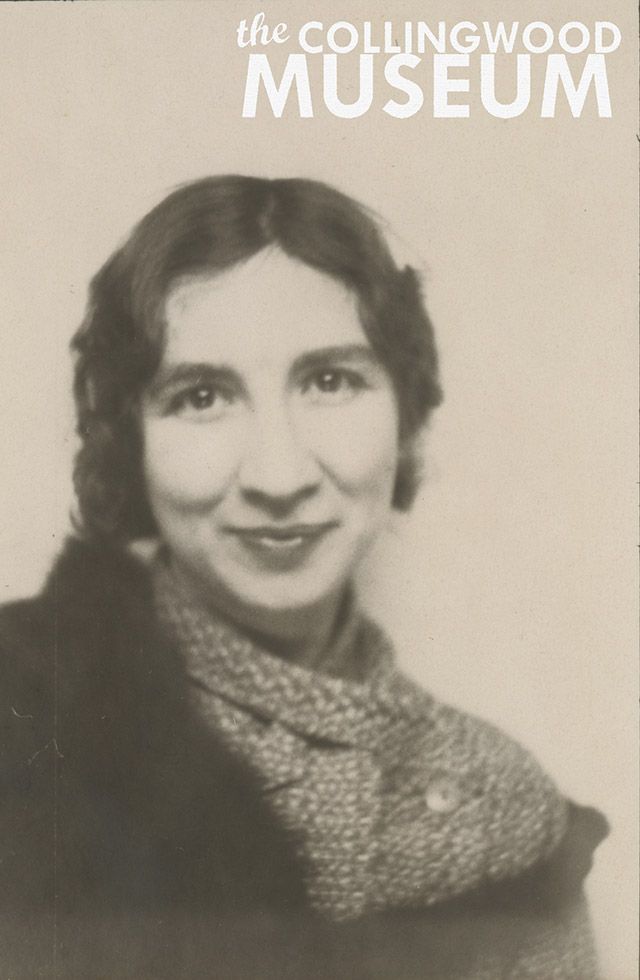
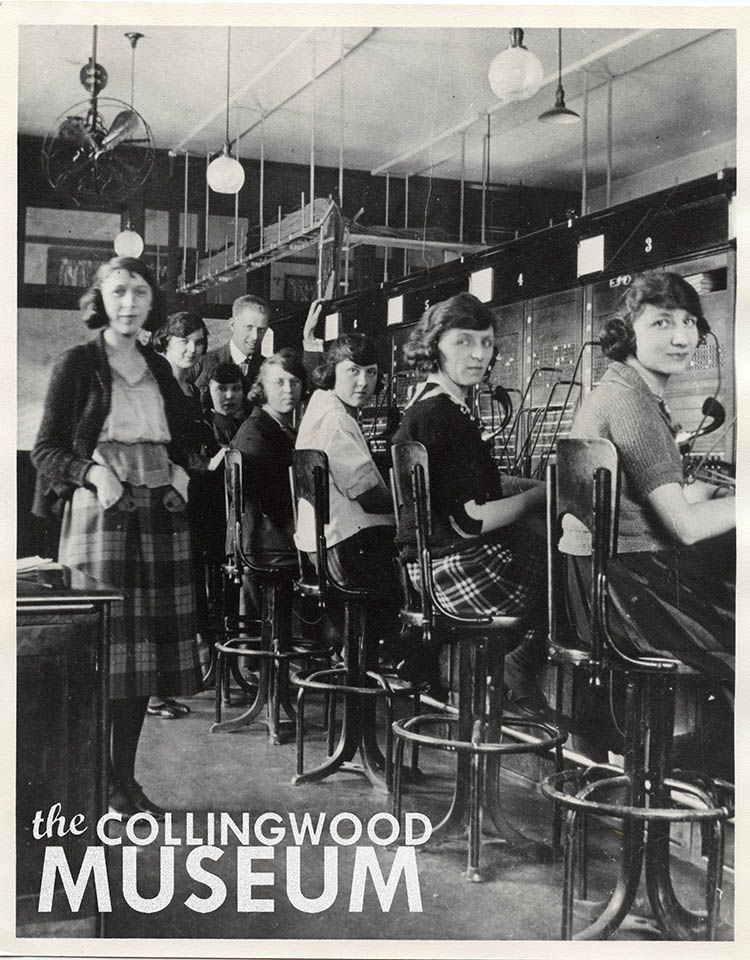
Left: Telephone operator Marjorie Wilson documented decades of life inside Collingwood’s Bell Telephone office, including the Depression and Second World War years. Collingwood Museum Collection, 2013.14.2 & 2013.14.1.
Below: Bell Telephone switchboard staff in Collingwood, 1922, including Chief Operator Muriel Brown and operator Marjorie Wilson. Collingwood Museum Collection, 986.14.1.
The first switchboard used here in town was the Gilliland, named after its inventor, Ezra Gilliland, a close friend and partner of Thomas Edison. Some 40 subscribers, mostly businesses and professionals, were listed for Collingwood in the 1886 directory. Among the early adopters was the Grand Central Hotel, which was remembered for accommodating Lord and Lady Stanley when they… but that is a story for another day.
On this day we are more concerned with the Hotel’s telephone, which was the Blake Magneto wall set. The first standard telephone of the Bell Telephone Company of Canada, these sets were made of three boxes: the top box contained the magneto generator, which the caller cranked to ring the central switchboard; the middle box contained the mouthpiece for the transmitter; and the lower box contained a wet battery, which supplied the necessary electrical current.
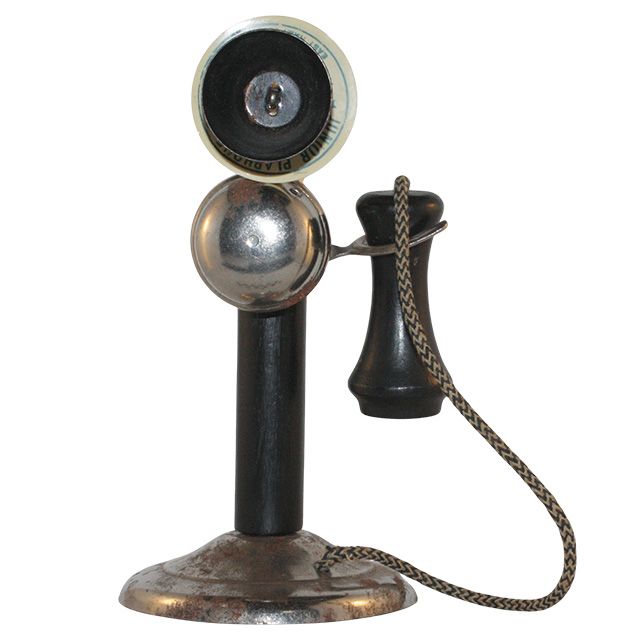
Toy telephone owned by Mirelda McIntyre of Collingwood Township, circa 1922. Collingwood Museum Collection, 996.16.5.
Telephone numbers were first used in 1897. For the first decade here in Collingwood, telephone subscribers were asked for by name only. And what is more, round-the-clock continuous phone service would only come into being in 1901. Before then, you could only call someone between the hours of 8:00 a.m. and 8:00 p.m. on weekdays, 2:00 p.m. to 4:00 p.m. on Sunday, and 10:00 a.m. to 12:00 p.m. and 2:00 p.m. to 4:00 p.m. on holidays. And long-distance calling? It didn’t exist. At least not until the first direct line to Toronto was finally brought to Collingwood in 1905.
E. R. Carpenter was replaced as agent by W. H. Gregory on Nov. 1, 1903, and the 100th telephone was installed in Collingwood that year. This in a town of around 5,000 people at the time. It was beginning to seem by that time that this telephone machine might have some legs. And yet it wouldn’t be until 1917 that the Bell Telephone Co. would hire architect William J. Carmichael to build for them a home of their own. This handsome building at 150 Hurontario Street, still there to this day, was erected when it became obvious that the telephone business was more than just a passing fad. The dial office was located on Fifth Street. E
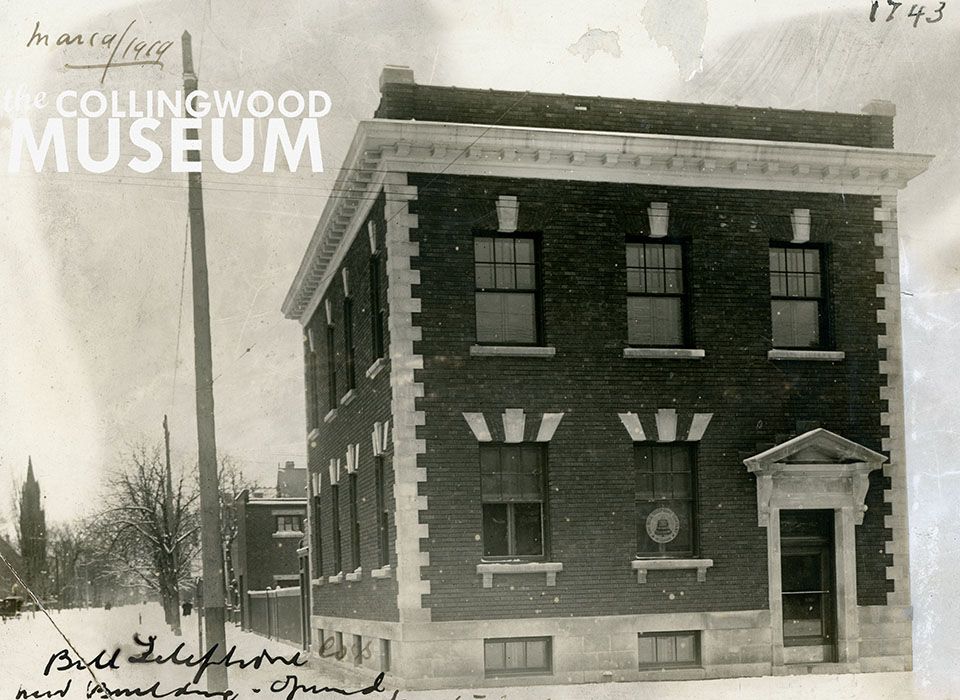
The Bell Telephone Company building at 150 Hurontario Street, designed by architect William J. Carmichael and opened in 1919. Collingwood Museum Collection, X972.2.1; Huron Institute Collection No. 1743.