
Beyond the Market
by Desmond Von Teichman

Understanding our local market.
Location, location, location. Literally everyone has heard that expression as it pertains to real estate. There are other factors that influence value, to be sure, but location is a pillar of any real estate value proposition. Think “Waterfront.” Think “Downtown Walkable.” Think “Uninterrupted Views.”
Location is arguably the single most important thing when it comes to real estate value. Why then do we habitually undervalue the concept of “local” when talking about real estate and the real estate market?
This has been very evident this past year. The market in Southern Georgian Bay was unique in Ontario. I can’t tell you how many times friends from the GTA and Golden Horseshoe came up to me in 2025 with sympathy in their eyes and said, “Tough market, eh?”
Tough…yes. It was a tough market. We were managing an enormous change in seller expectations and managing the uncertainty in the minds of buyers. “How far will rates go down? I don’t want to lock in too soon.” “How will US tariffs affect the real estate market?” It was a tough year.
BUT the numbers for the Southern Georgian Bay market were not at all bleak. They were, however, uniquely local. Just like us. Just like this region.
The last Market Watch I wrote at the end of 2024 ended: “In my opinion, demand in 2025 will be on the rise and start to absorb existing supply.
Indicators are that we will see continued price appreciation as we make our way through 2025.”
And that is exactly what happened. Here…locally. In most other markets in Southern Ontario, this was not the case. And people who only listen to the national or provincial-level reporting, or who are mostly familiar with other markets, can be forgiven for missing the complexities and nuances of this local market.
The 2025 macro news cycle spoke about uncertainty and the effect of that uncertainty on buyers, and the resultant decrease in volume, unit sales, and prices. In many other markets, that was indeed the case, but not here. Our market was certainly affected by uncertainty, and it was what I can only describe as “lumpy.”We did not at all follow the traditional seasonality of a normal market. We saw peaks where we expected to see valleys, and valleys where we would ordinarily have predictable volume increases.
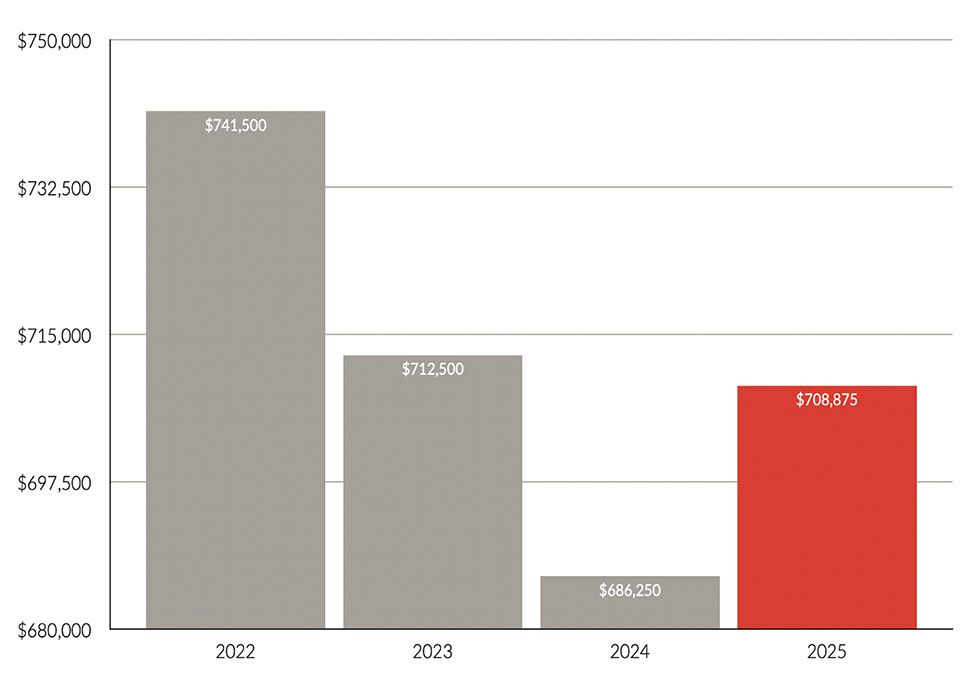
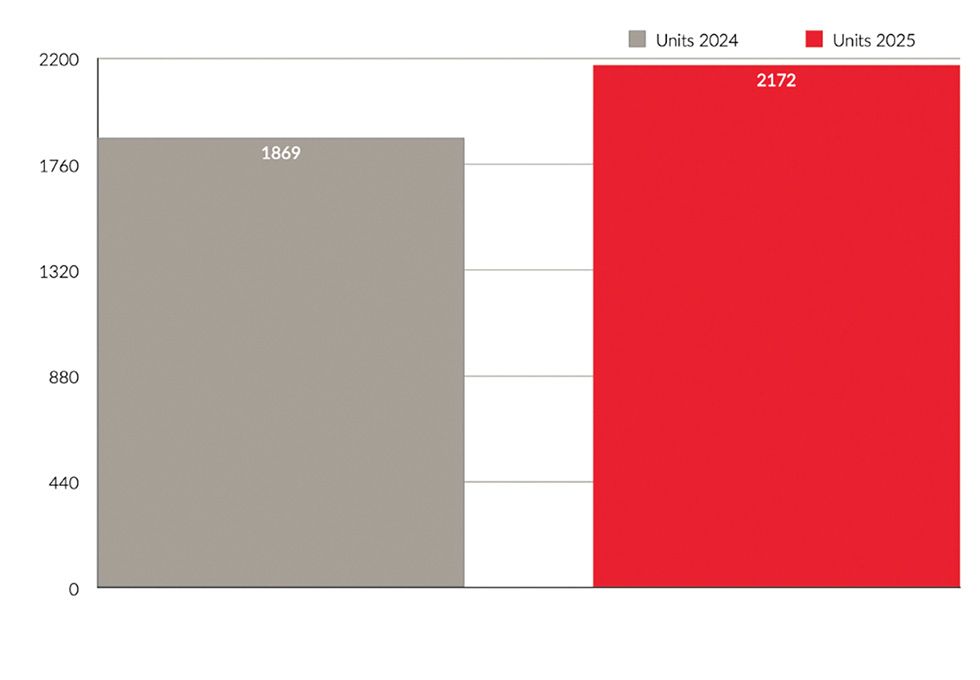
But if you look at the year in Southern Georgian Bay as a whole, 2025 saw a substantial increase in volume in the real estate market. Volumes soared in 2024 by 22% over 2023. That number was led by properties on the median end of the market (sub-million-dollar). Unit volume saw an increase that was a touch more modest, but still a notable 16% increase to over 2,100 units.
That increase in volumes contributed to a more muted increase in average sale price of just under 6% to just over $832,000. Muted, yes…but still an increase. A microcosm of good news in a province that generally saw decline.
Now…not all segments of the market saw identical trajectories. Like many parts of the province, the condominium market was not as robust as freehold. Single-family dwelling sales last year were up almost 31%, compared to condominium volume, which only rose by 16%. And the average sale price was also affected, with the average sale price of condominiums declining by just about 7%. A decline, to be sure, but not as sharp as demonstrated in many markets to the south.
So…in general, 2025 was not a bad year in Southern Georgian Bay. No question, it was a tough year. No market is immune to uncertainty. But as I have repeatedly indicated in these pieces, the fundamentals of this market are excellent.
What will 2026 bring us? More uncertainty, to be sure, at the time of writing. And the numbers so far in the first quarter give us reason to pause. As of the end of February, all indicators are flat or lagging behind 2025 a touch. Unit sales, for example, are off just under 1% year to date over the same period last year.
But that is the winter market. And what a winter we had! No one can be blamed for not heading out on a road trip to see a bunch of houses in a blizzard in February.
But as the seasons turn and we head into spring, I am anticipating a steadier and more predictable market—one that starts to normalize into the seasonality we would expect.
External influences aside (and there are many), the fundamentals continue to look good. After a post-pandemic decrease in volumes and prices, the trend lines point to a reversal of this. Interest rates have stabilized. The economists I follow and respect seem to indicate stability for the rest of the year, and a move to increased borrowing rates in 2027. While the market is not yet balanced, it is headed in that direction.
What does that mean? In a buyer’s market, it is a good time to be a buyer. A good time to buy. And our clients are figuring that out. I have loved seeing the resilience of our country in a time of strife. The resulting Buy Canadian movement has been interesting to watch. I think it is a good metaphor for examining the local market, as opposed to thinking that the same thing is happening everywhere.
Right now, in a time of divergent trends, understanding local, consulting local, and shopping local have never been more important. E