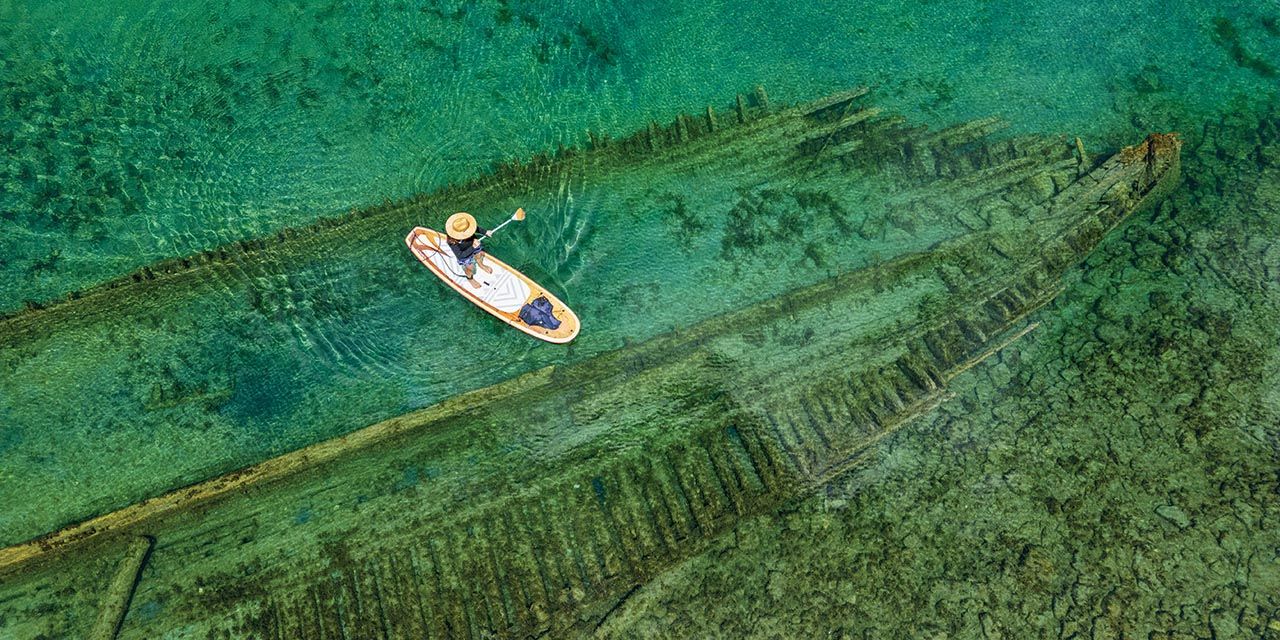
The Cyrenian is one of the Bruce Peninsula’s most accessible wrecks. Resting close to shore, she met her demise during the White Hurricane of 1913. SUP rental board provided by Jack n Jill’s Surf Shop, Sauble Beach. More photos below.
Shallow Shipwrecks
By Cara Williams | Photography by Clay Dolan and Sacha Oke
Beneath the clear waters of Georgian Bay and Lake Huron, century-old wrecks lie close enough to see from the surface—if you know where to look.
At first, it looks like shadows beneath the water. Then the shapes sharpen: ribs, keels, boilers—the remains of shipwrecks lying just below the surface. On calm summer days along Georgian Bay and Lake Huron, the water can turn glass-clear, transforming the lake into a window onto the bottom. Paddle quietly enough and entire vessels begin to appear—some in remarkably shallow water: century-old schooners, steamers and tugboats still visible from kayaks, paddleboards and small boats drifting overhead.
Lake Huron, including Georgian Bay, holds an estimated 1,000 shipwrecks—some lost to storms, some to fire, some to reefs that rose too suddenly beneath wooden hulls that had no time to turn. Most are hidden in deep water or buried by time. But the conditions here—cold freshwater, pale limestone beds, the shelter of bays— conspire to preserve what the lake takes, and in a few extraordinary places the wrecks are close enough to the surface that the past is, at times, within arm’s reach.
This list only begins to chart what lies below. There are more wrecks, more stories and more strange shadows waiting in clear water. For now, consider this a first pass over a few of the region’s most accessible sites—an introduction to one of the Great Lakes’ stranger pleasures: drifting in bright sun directly above the disasters that made them.
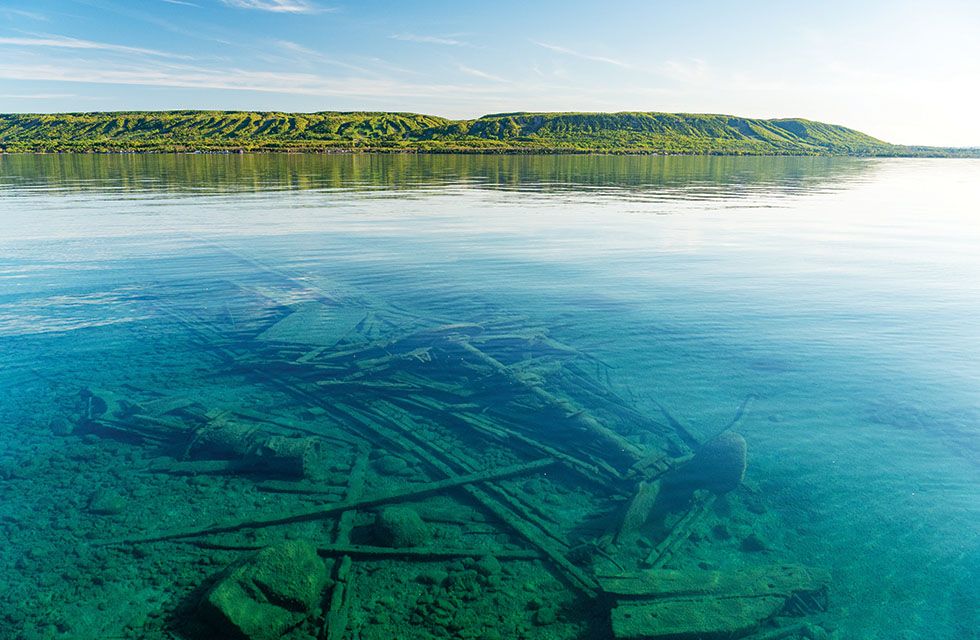
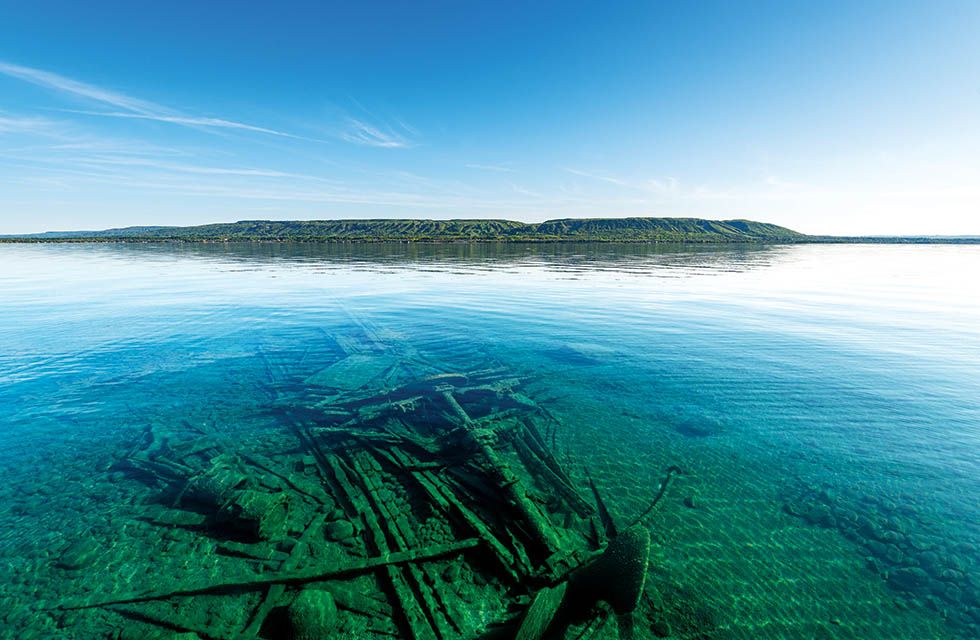
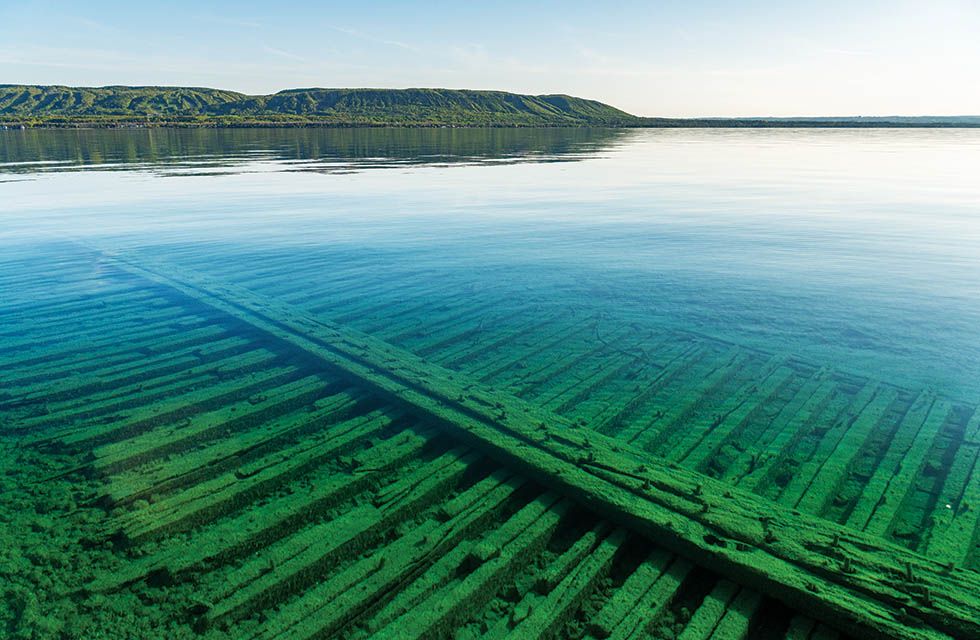
The Mary Ward rests on a shallow shoal off Craigleith—more than 150 years after she ran aground.
Craigleith & Northwinds Beach | The Blue Mountains
The wreck of the Mary Ward is part local legend, part summer outing, part warning. On November 24, 1872, the 129-foot wooden steamer ran hard aground on Milligan’s Reef, roughly two kilometres off the Craigleith shore. She was carrying 27 people and was bound for Collingwood when something went awry. The cause was never fully settled. Some believe the captain saw the lights of Craigleith, mistook them for Collingwood, and turned toward shore too soon. Others point to fog, unfamiliar waters or simple human error.
At first, there seemed to be time. By all accounts, it was a calm autumn night. The first lifeboat reached Craigleith safely, and those aboard set out to bring back the tug Mary Ann by morning. But the tug had been laid up for winter, and by the time it was readied, the weather had turned too violent for it to reach the stranded steamer.
A fierce gale rose over the shoal and waves began breaking over her upper decks and wheelhouse. The captain and seven other men launched another lifeboat, but made it only as far as Nottawasaga Lighthouse Island, where the small boat nearly broke apart trying to reach shore. Later, in a final desperate attempt, eight men boarded the last lifeboat. It capsized almost as soon as it launched, and all eight drowned.
Those still clinging to the Mary Ward were eventually rescued by a local party of fishermen—an act of courage later recognized by the Canadian government. The only further casualty was the ship’s mascot, a dog, which fell into the water during the rescue and was last seen swimming toward shore on the crest of a breaker. Milligan’s Reef has carried the ship’s name ever since; today, the shoal is known locally as Mary Ward Ledges.
On a still day, you’ll often find boats anchored near the wreck, paddleboarders and snorkellers tracing the outline of what remains. Look down and the story comes into focus piece by piece: heavy wood planking, the boiler and stack to the east, the propeller farther west, with engine parts and metal fragments resting among the shoals.
It is close enough to feel like a tourist attraction, but the mood changes quickly out there. Consider it a warning: the same shoal that can look inviting in July and August is the reason the Mary Ward never made Collingwood.
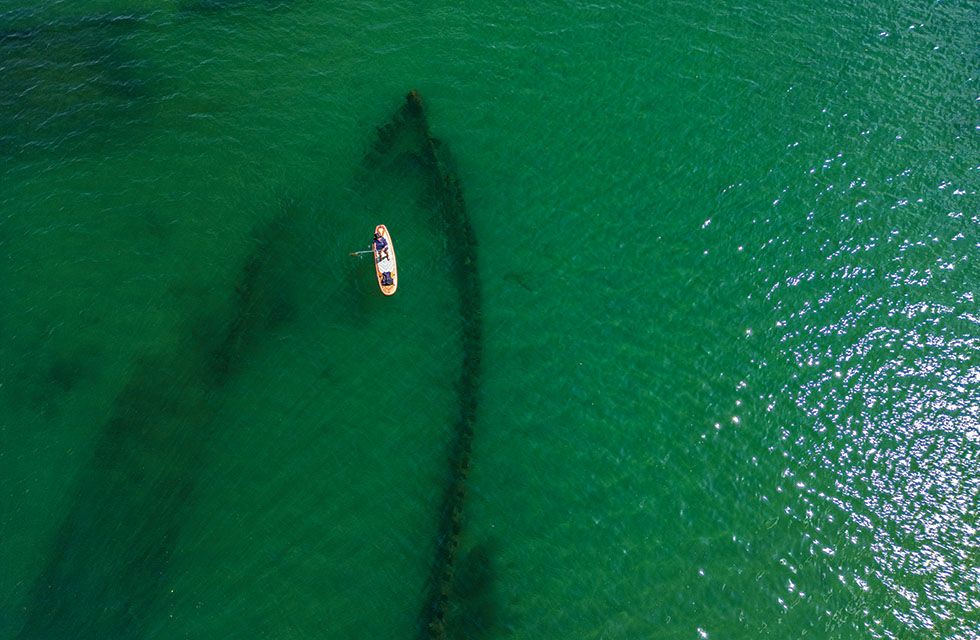
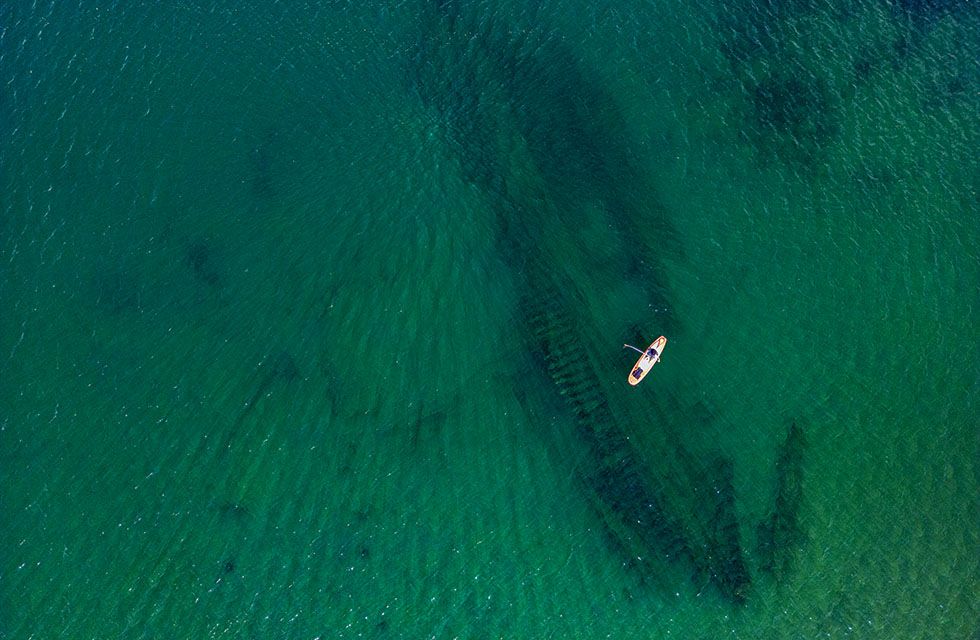
This wreck located near Owen Sound’s wastewater outfall is believed to be the Dan Proctor, a 200-foot, three-masted schooner.
Owen Sound Harbour | Georgian Bay
Owen Sound’s harbour has always been a working port— grain, steamers, industry—and it has been quietly keeping its secrets. Several wrecks went unfound until recent decades, surfacing not through treasure hunts but through routine surveys of the harbour floor. Marine archaeologists have suggested there may be more than 20 important wrecks within the harbour limits: a hidden fleet of wooden vessels, barges and schooners sunk, abandoned or discarded over generations.
The most striking came up in 2015, during upgrades to the city’s wastewater treatment plant. Sonar turned up a large wooden ship resting about 200 metres
offshore, near the sewage outfall. Archaeologists believe it is the Dan Proctor—a 200-foot, threemasted schooner built in Bay City, Michigan in 1893, originally named the Ed McWilliams and renamed in 1922. By 1930 she belonged to the Keenan Brothers, wood-products manufacturers who proudly claimed to be the only makers of flat toothpicks in the country. When the barge outlived its usefulness, they scuttled it in the harbour in 1936 and walked away. It sat there, forgotten, for nearly 80 years—until a sewage pipe project found it.
Portions of the hull can still be visible below the surface in clear conditions, though the harbour guards them unpredictably: weather, algae and boat traffic can close visibility without warning. The same survey found two more unidentified wrecks nearby—a reminder that Owen Sound’s maritime history is still being mapped. For a harbour built on grain, steamers and industry, the discoveries feel like echoes of the working port it once was.
What Makes These Wrecks
So Visible?
• Exceptionally clear freshwater
• Limestone lakebeds that reflect sunlight upward
• Cold water temperatures that slow decay
• Minimal marine growth compared with saltwater wrecks
• Sheltered harbours and reliably calm conditions
Best Ways to Experience Them
• Kayaking
• Stand-up paddleboarding
• Snorkelling
• Glass-bottom boat tours
• Small boat excursions
• Underwater photography
Safety & Preservation
Most of these wrecks are protected heritage sites. Don’t climb on the wrecks, remove artifacts or anchor directly over historic remains. Weather can change fast, especially around open-water shoals. For the Tobermory sites, Parks Canada regulates access through Fathom Five National Marine Park.
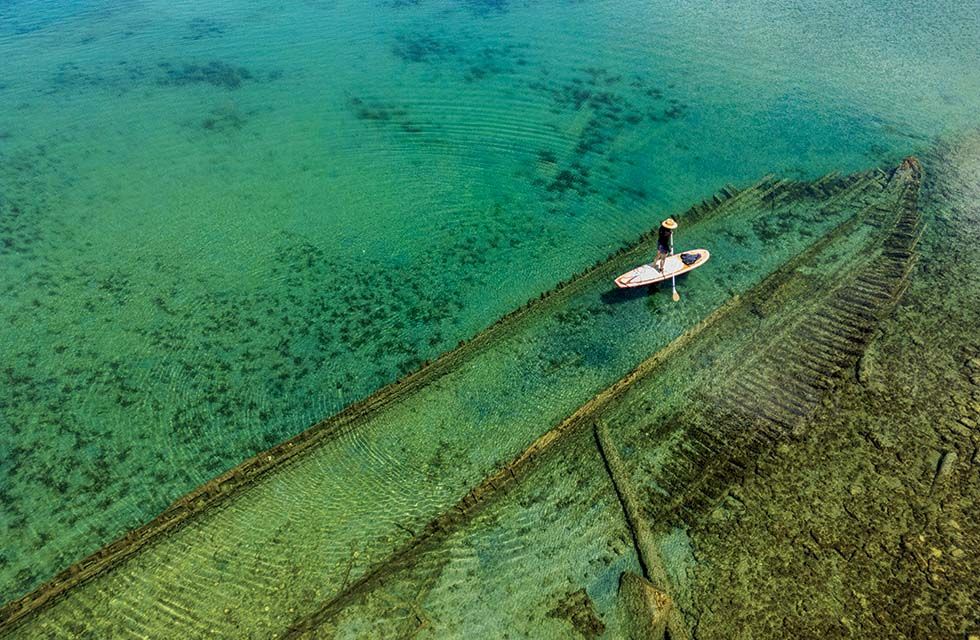
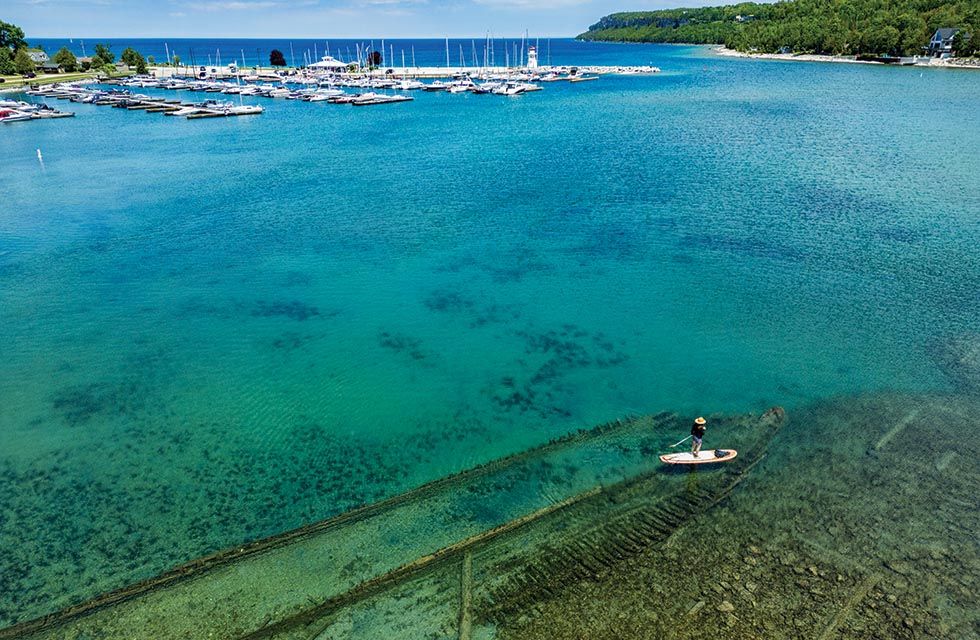
This wreck located near Owen Sound’s wastewater outfall is believed to be the Dan Proctor, a 200-foot, three-masted schooner.
Lion’s Head | Bruce Peninsula
Farther north in Lion’s Head Bay, two more wrecks lie close enough to shore to feel almost within reach. The Cyrenian, formerly the Prussia, was a wooden schooner built in 1879. During the White Hurricane of November 1913—one of the deadliest storms in Great Lakes history—she broke loose from her moorings in Lion’s Head Bay and drifted to where she now rests.
Today, the Cyrenian lies just off the public beach in shallow water, making her one of the easiest wrecks on the Peninsula to reach without a boat or a scuba tank. What remains is no longer a complete ship, but two disjointed sections: the bottom and part of one side, still visible through the surface on calm days.
Nearby, the W.E. Gladstone—also known as the Ann Long—rests in slightly deeper water. A 72-foot wooden tug built in 1881, she has been reduced by time to part of her bottom and one side, with what appears to be a section of stack still on site. Less complete than the Cyrenian, she is quieter and easier to miss, but part of the same small congregation of wrecks along Lion’s Head’s waterfront.
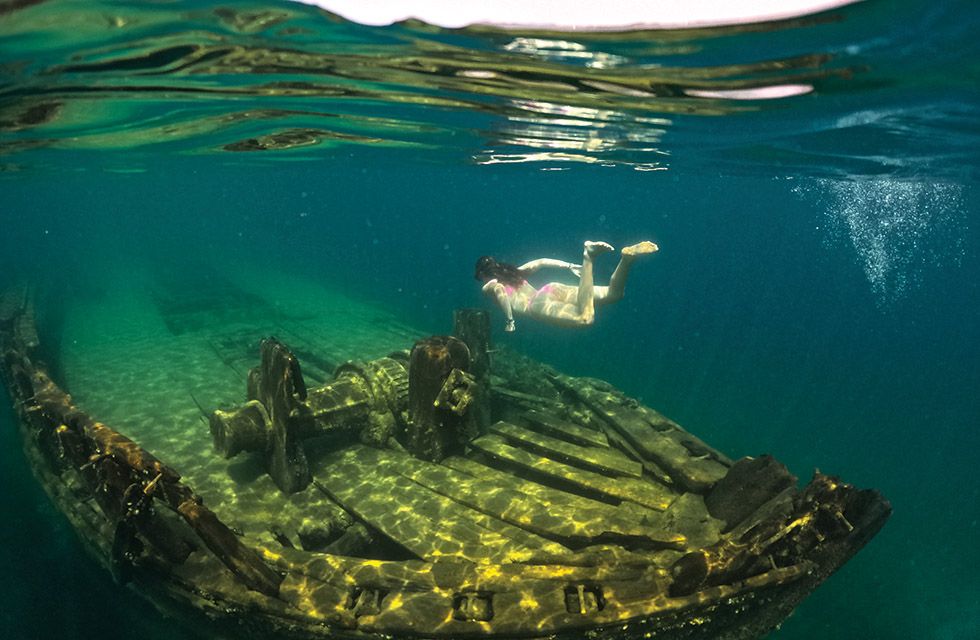
The Sweepstakes is one of Fathom Five National Marine Park’s most famous wrecks. Built in 1867, it sank in 1885 after striking rocks near Cove Island. Photo by Sacha Oke.
Fathom Five National Marine Park | Tobermory
Tobermory sits at the tip of the Bruce Peninsula where Georgian Bay meets Lake Huron, and the waters around it hold more shipwrecks per square kilometre than almost anywhere else in North America. Fathom Five, Canada’s first national marine park, encompasses more than twenty known wrecks in conditions that have kept them startlingly intact—cold water, limestone beds, and the shelter of the harbours conspiring to preserve what the lake takes. Some require boats and dive equipment. Several do not.
The easiest place to start is “The Tugs”. Tucked in Little Tub Harbour, the site holds the remains of four small working tugboats—the Alice G, the Robert K, the John and Alex, and a fourth whose name sources disagree on (variously called the Bob Foote; Parks Canada lists it as unidentified)—most of them burned before they slipped beneath the surface close to shore. They rest in just a few metres of water now, shallow enough that ribs, hull fragments, propeller shafts and loose machinery show plainly from above on a calm day. The Alice G is the most complete and the easiest to make out; the others lie scattered across the rocky bottom, some in less than 10 feet of water. There is something chummy about four little boats settled together in the shallows—a fleet that never truly left port. Best of all, you can simply walk in: stairs down to a viewing platform and change facilities at the water’s edge, no boat or certification required. It has become the first stop for families and new divers feeling their way into Fathom Five.
A short paddle away, in Big Tub Harbour, the Sweepstakes never meant to stay. In 1885 the two-masted schooner—built in Burlington in 1867—was hauling coal when it tore open its hull on the rocks off Cove Island. Crews towed the wounded ship into the shelter of the harbour to patch it up, and there it quietly gave out, settling to the bottom before the repairs were ever finished. More than a century later, much of its wooden hull still holds shape only a short distance from shore. From a kayak, paddleboard, snorkel tour or glass-bottom boat you can spot what’s left—the long curve of the hull, the exposed ribs, the centreboard box, the last lengths of bow railing.
Beside it lies a darker story. The City of Grand Rapids was an elegant passenger steamer built in Grand Haven, Michigan in 1879. It caught fire at its dock in Little Tub Harbour in October 1907. With the flames threatening the boats and buildings crowded along the waterfront, crews made a hard choice: they towed the burning ship into Big Tub and cut it loose. It burned to the waterline and went down. Today it lies in about 15 feet of water, and where the Sweepstakes is whole, the City of Grand Rapids is ruin charred, collapsed, skeletal. Its blackened ribs and twisted remains make it one of the eeriest sights in the province: an entire ship reduced to a shadow, lit from above by the same bright water that makes it so easy to find.
Then there is the W.L. Wetmore, and the way she went down. On November 29, 1901, the 214-foot steam barge was running hard for Tobermory in a storm, towing two barges stacked with lumber out of Parry Sound, when she was driven onto the rocks off Russell Island and broken apart by the surf. One of the barges, the James C. King, may have burned and sunk nearby. The Wetmore herself lies in about 25 feet of water today—and her boiler, upended by the violence of the wreck, has risen approximately 15 feet off the bottom. On a calm day, a snorkeller swimming above it can reach down and nearly touch it: a piece of a November storm from 1901, close enough to put a hand on.
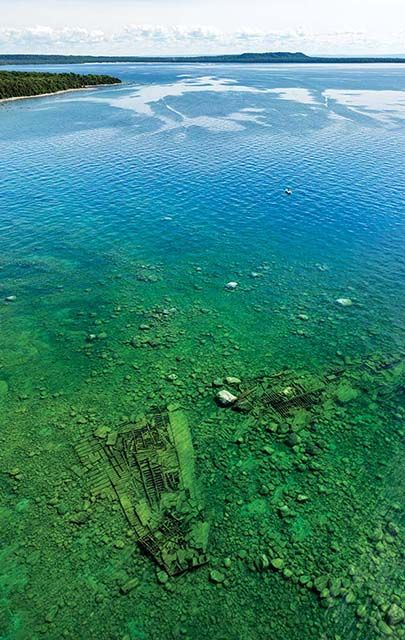
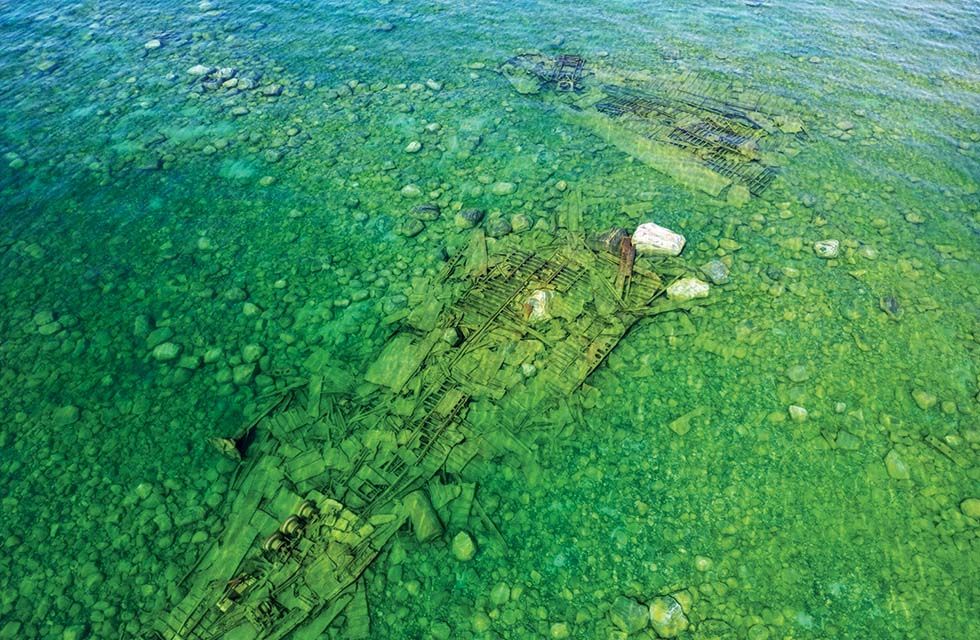
The Michigan, a former car ferry turned salvage barge, rests in clear water near Hope Island—its boilers, gears and heavy machinery scattered across the lakebed.
Hope Island | Southeastern Georgian Bay
The shoals around Hope Island, off Christian and Beckwith islands, hide one of the richest collections of shallow wrecks in Ontario—three ships in particular: the Lottie Wolf, the Marquette and the Michigan. The water here is exceptionally clear, the rocks that sank these vessels lie close to the surface, and several sites are within reach of strong kayakers, snorkellers and novice divers when the bay is calm. Three ships. Three very different ways to go down.
The Lottie Wolf was a three-masted wooden schooner built in Green Bay, Wisconsin in 1866, loaded with corn when she struck a shoal off Hope Island in 1891. Although no lives were lost, the sailors who’d worked her decks reportedly mourned her as they would an old friend. The ship itself is long flattened, its wooden bones spread across the lakebed, but that wreckage is its own kind of museum. Exposed ribs, timbers, a sail winch and old iron hardware lie open to the light: a diagram of how a 19th-century sailing ship was built, drawn on the bottom of the bay.
The Marquette kept its secrets longer. The schooner sat unidentified for decades after it was found, mysterious enough to become the subject of a five-year Ontario Marine Heritage Committee study on how such wrecks decay— and how divers wear them down. More survives here than at the Lottie Wolf: you can still pick out sections of hull, the centreboard casing and the great anchors lying where they finally came to rest.
The Michigan breaks the pattern entirely. It is among the most photogenic wrecks in Georgian Bay, and the strangest—a tangle of dark metal resting beside its elegant wooden neighbours like a different century dropped onto the same floor. She was built in 1890 as a car ferry—later converted to a salvage barge, the kind of ship sent out to rescue others in distress. The irony is, she was lost while trying to free another vessel, the Riverton, stuck on the rocks with a cargo of grain, and was herself driven onto the shoals before she could get it clear. There is no graceful wooden hull here—instead, a sprawling field of iron, boilers, gears, cranes and the heavy machinery of a working salvage ship, all of it frozen mid-collapse.
Hope Island is Beausoleil First Nation territory; check current access, fees and visitor requirements before going at chimnissing.ca. E