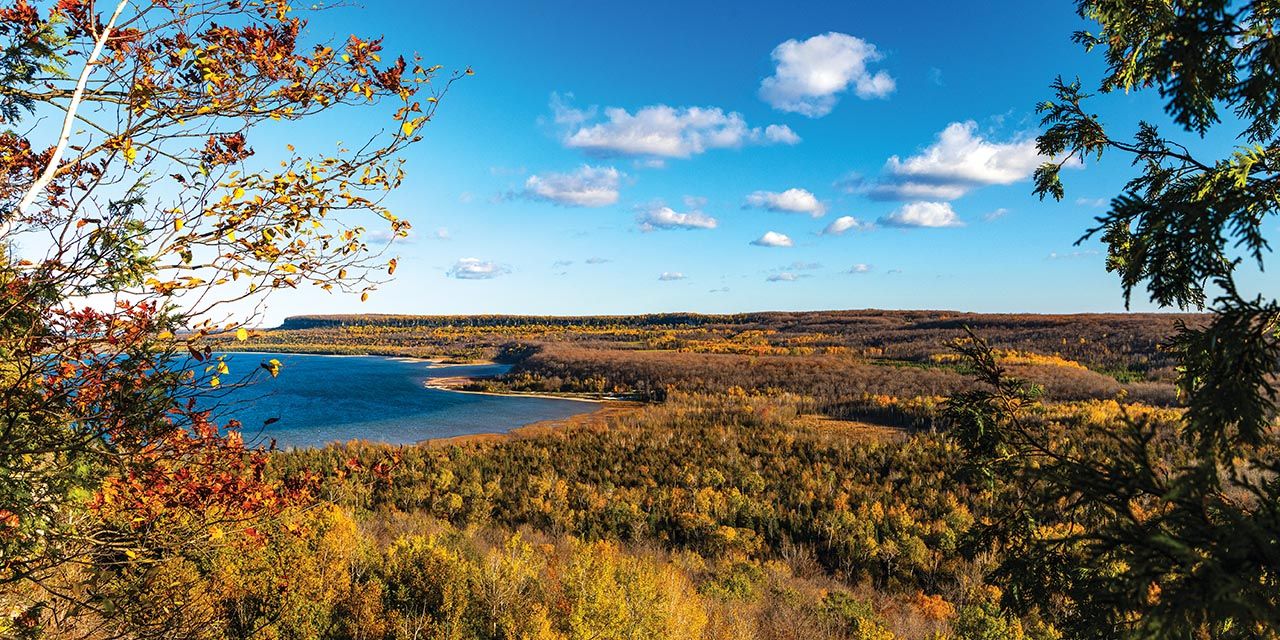
The reward for leaving the road behind: a fall view across the Saugeen (Bruce) Peninsula that can only be appreciated on foot.
A Trail for Every Hiker
By Cara Williams | Photography by Clay Dolan
The best hike is not necessarily the longest route or most famous lookout—it is the one suited to the day, the conditions and the people walking it.
At Jackson Cove Lookout, high above Hope Bay, the hikers stopped long enough for a photograph. Behind them, the Niagara Escarpment fell toward Georgian Bay; ahead waited another long stretch of the Bruce Trail. It was mid- October, and the group was on Day 2 of a six day end-to-end journey organized by Peninsula Bruce Trail Club (PBTC) Hike Leader Margie Gloade. By the end of the following day, the group tallied 91.3 kilometres and 22 hours and 45 minutes across the first three days. They finished that third stage around 5:15 p.m., very wet and still moving north.
“The weather had been a bit misty and rainy, but it was beautiful and clear at that moment,” Margie recalls of Jackson Cove. “Then we just randomly ran into Clay, who happened to be a professional photographer. That was very exciting,” she says of Escarpment® Magazine publisher Clay Dolan.
The chance encounter turned into a lasting record of the day. The resulting photograph captures something essential about hiking the Saugeen (Bruce) Peninsula in fall: reaching a view you would never see from the road, then stopping long enough to enjoy it. The Peninsula section begins in Wiarton and follows the Escarpment for approximately 163 kilometres to the Bruce Trail’s northern terminus in Tobermory. Along the way, it crosses cedar forest, dolostone ledges and Georgian Bay shoreline, climbing to lookouts where the water can appear almost tropical.
Underfoot, however, this is no Sunday stroll. The Peninsula is considered one of the Bruce Trail’s more challenging sections, with exposed roots, deep fissures, steep ascents and rocky scrambling. Access points become farther apart toward Tobermory, and cell service can be unreliable. That combination of beauty and difficulty is precisely what makes the Peninsula so compelling. It also means there is no single way to hike it. For an experienced distance hiker, a six-day end-to end is the answer to a very large question: Can you cross the entire section on foot?
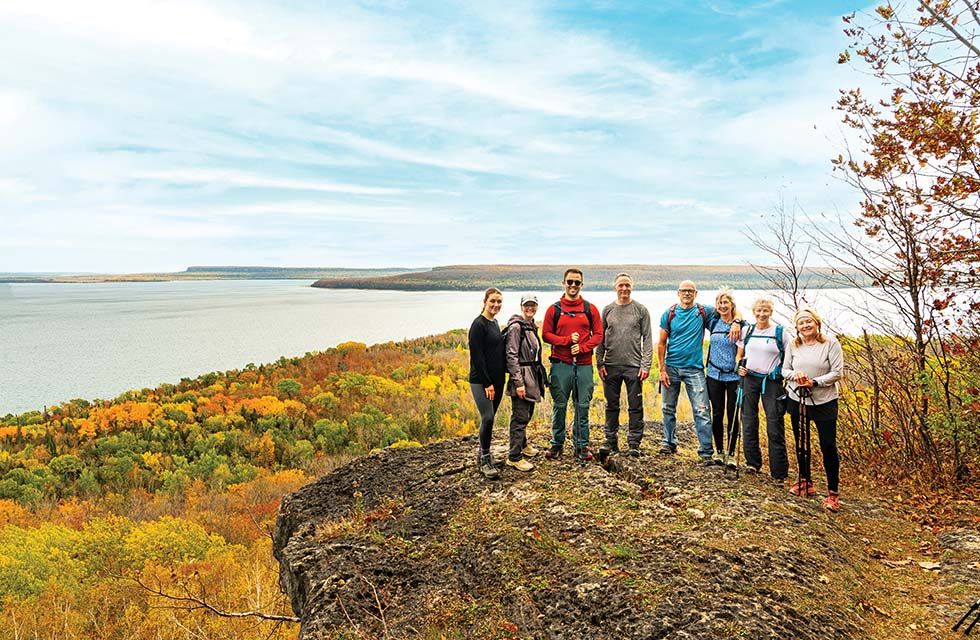
Hikers pause at Jackson Cove Lookout during Day 2 of a six-day Peninsula end-to-end led by Peninsula Bruce Trail Club.
In this case, the PBTC’s itinerary divided the trail into stages of approximately 24 to 33 kilometres. Participants were expected to maintain a brisk pace over difficult terrain for seven to nine hours each day—with a short recovery built in partway through. As a trail runner, Margie was accustomed to covering long distances. Hiking them proved to be a different test. “I thought, ‘I can do that, no problem,’” she says. “But just the time on your feet hiking—it was really hard, very, very challenging, but a lot of fun.”
“The trick with the Peninsula is that there are logistics involved,” Margie says. “The parking is pretty spaced out, and the parking lots don’t all hold a lot of cars.” In addition, food, water, first-aid supplies and rain gear must be carried. Weather and daylight have to be watched. Every participant needs enough experience to understand both their abilities and their limits. For this small group, everyone met at the day’s endpoint before consolidating into fewer cars and driving to the start. At the end of the hike, their vehicles were waiting—but arranging that simple convenience required careful planning.
Margie led from the front and arranged for a different sweep to travel at the rear each day. Experienced Hike Leader Shawn Radcliffe served as the sweep on Day 2. The sweep watches the back of the group, helps manage its pace and ensures no one is left alone on a remote stretch of trail. “Even on Day 2, I could tell we had a really fabulous group of people—a real mix,” she says.
The group included a mother and daughter, Margie’s husband and her cousin, and three people who had registered individually. Long days created their own kind of trail community. There were quiet kilometres, interesting conversations, lunch at lookouts and plenty of laughter. “I think that’s the really fun part of joining an organized hike,” Margie says. “You get to meet people who enjoy a similar activity, people you might not otherwise get to meet.”
The end-to-end challenge is only one way to experience the trail. Earlier in 2025, Margie helped lead PBTC’s first trail-running end-to-end, an eight-day series designed for experienced runners. At the other end of the spectrum, the club has offered an 18-hike end-to-end with daily distances generally ranging from eight to 12 kilometres.
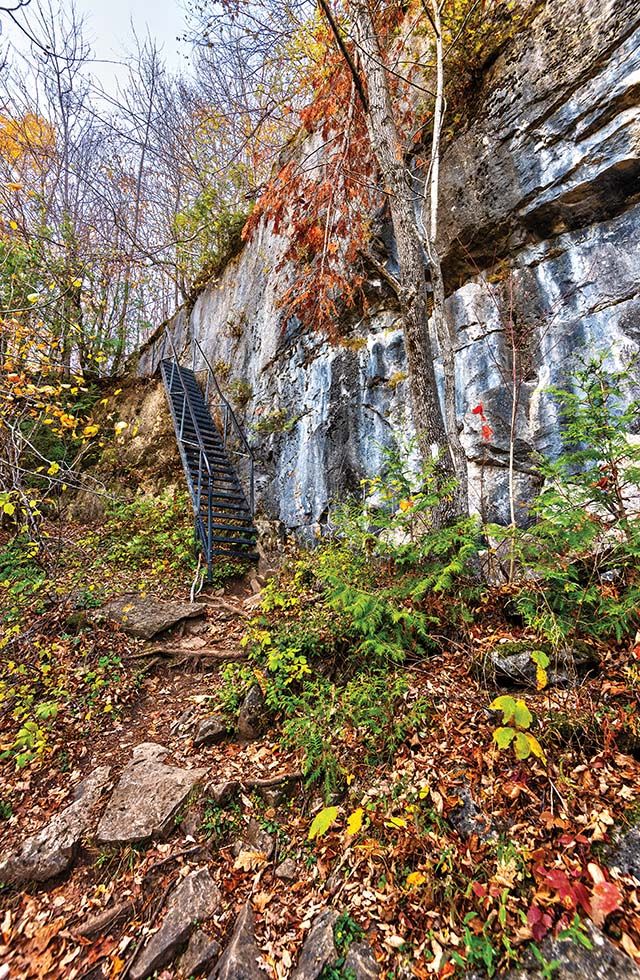
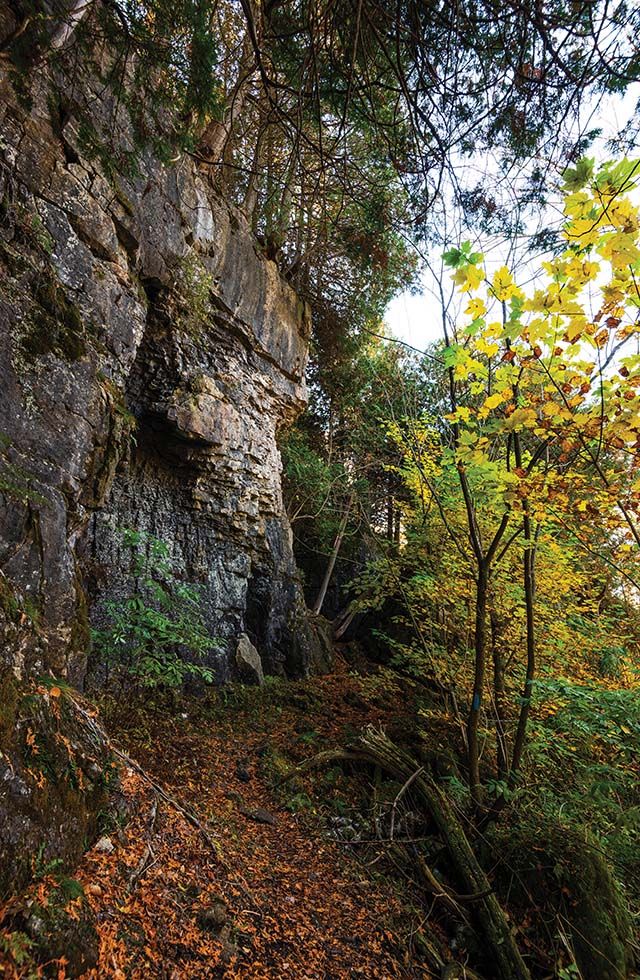
Roots, dolostone ledges and even manmade ladders are all part of the terrain on the Peninsula section of the Bruce Trail.
Beyond end-to-end programs, the club organizes outings around birds, ferns, orchids, trees and geology, as well as sunrise, moonlit and mindfulness experiences. The variety helps people find an entry point suited to their interests and abilities.
Geologist and author Beth Gilhespy has led hikes that read the Peninsula’s cliffs, fossils and glacial features as a record of deep time. Sunrise outings begin in darkness and arrive at the Escarpment edge with the changing sky. During one mindfulness series, participants began with a sensory meditation, left their phones behind and walked much of the route in silence.
PBTC’s Blue Series turns attention toward the side trails. Its 2026–27 Sunday program is planned as 27 outings covering more than 150 kilometres and 78 side trails. Hikers pursuing the adult Peninsula Side Trails badge must eventually walk them all; younger hikers can earn a Bear Cub badge by completing four side-trail loops.
For those looking for a shorter introduction, Bruce’s Caves Conservation Area near Wiarton offers adventure on a different scale. A moderate trail of approximately 2.9 kilometres leads through forest to openings in the Escarpment face created by wave action from post glacial Lake Algonquin roughly 7,000 to 8,000 years ago. Here, the drama is close enough to touch: layered stone, moss, shadow and sweeping curves carved when water levels stood far above present-day Georgian Bay. The conservation area also provides access to the Bruce Trail for hikers wishing to extend their outing.
Here, the drama is close enough to touch: layered stone, moss, shadow and sweeping curves.
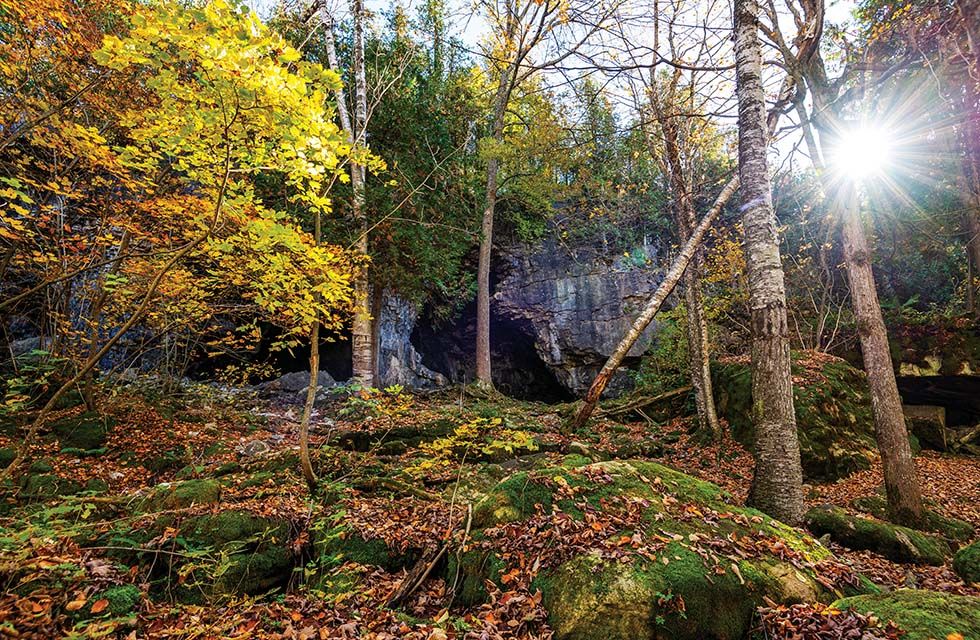
At Bruce’s Caves Conservation Area, openings carved into the Escarpment by ancient wave action offer a dramatic—and much shorter—way to explore the Peninsula on foot.
Autumn sharpens the Peninsula’s contrasts. Maples and birches flare above dark conifers. Fallen leaves gather in the hollows of the dolostone. Low light brings texture to the cliff face, while Georgian Bay shifts from brilliant blue to hammered grey with the weather. Those same leaves can conceal roots, loose rock and deep crevices. Rain makes the stone slippery, and shorter days leave less room for a delayed start or wrong turn. Margie recommends carrying extra water, a small first-aid kit, hiking poles, sturdy footwear and a flashlight or headlamp. On longer outings, the light belongs in the pack even when the plan is to finish before dark. “It’s always a good idea to be overly prepared,” she says.
Parking also demands a plan. Popular trailheads and conservation-area lots can fill, particularly during the fall-colour season. Requirements vary by location, so hikers should check current maps, trail notices and official parking information before leaving home. If a lot is full, the responsible choice is another hike—not an improvised parking spot or a new route across sensitive or private land.
White blazes mark the Bruce Trail’s Main Trail and blue blazes identify side trails, but paint alone does not keep a trail open. PBTC volunteers inspect and clear the route, renew blazes, lead hikes, monitor protected properties, collect litter and maintain relationships with landowners. Their work allows a visitor to concentrate on the trail rather than everything required to sustain it. It also carries a request: remain on marked routes, carry out everything you bring in, camp only where camping is permitted and resist stepping beyond the trail for a better photograph. The lookout is not separate from the choices that preserve it.
At the Tobermory cairn, the white blazes come to an end. For a six-day group, it is a place for a badge, a photograph and the satisfying knowledge that every kilometre now lies behind them. E