Joe Lammers savours a fresh snowfall under sunny skies.
Keep the Stoke High
By Cara Williams | Photography by Clay Dolan
Legendary powder, North America’s longest vertical, and a mountain town with soul—Revelstoke is where the stoke stays high, the terrain stays honest, and the love of snow sports runs deep.
I’d been hearing about Revelstoke Mountain Resort long before I ever skied it. When I was living in Whistler, rumours drifted through town that a new resort might open somewhere in British Columbia’s interior—farther to get to, yes, but possibly closer to the soul of skiing and snowboarding. The question lingered: would people really travel there, drawn less by hype and more by snow, depth, and the quality of the terrain itself?
They would. They do. And once you arrive, it makes perfect sense.
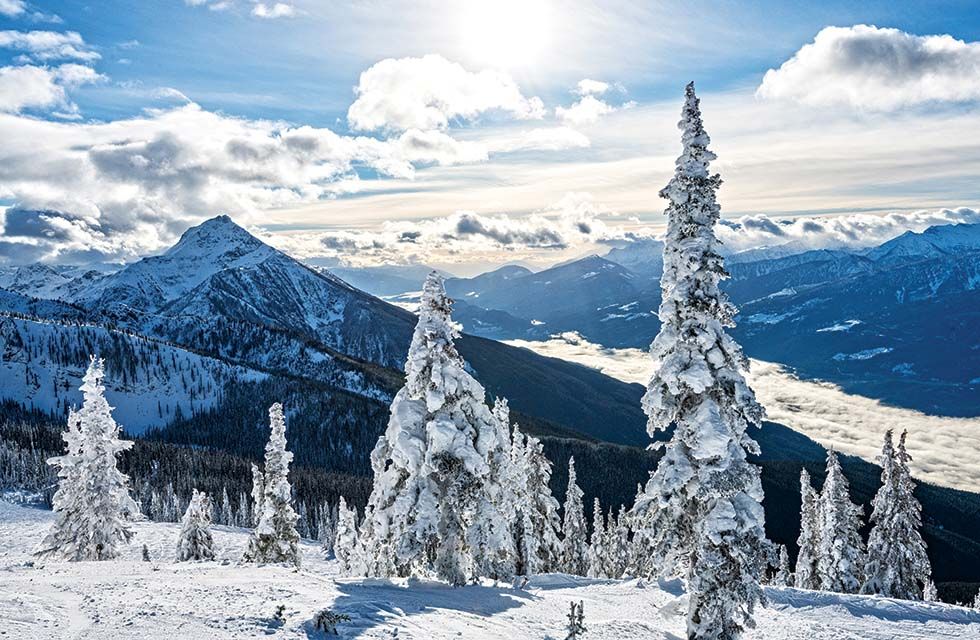
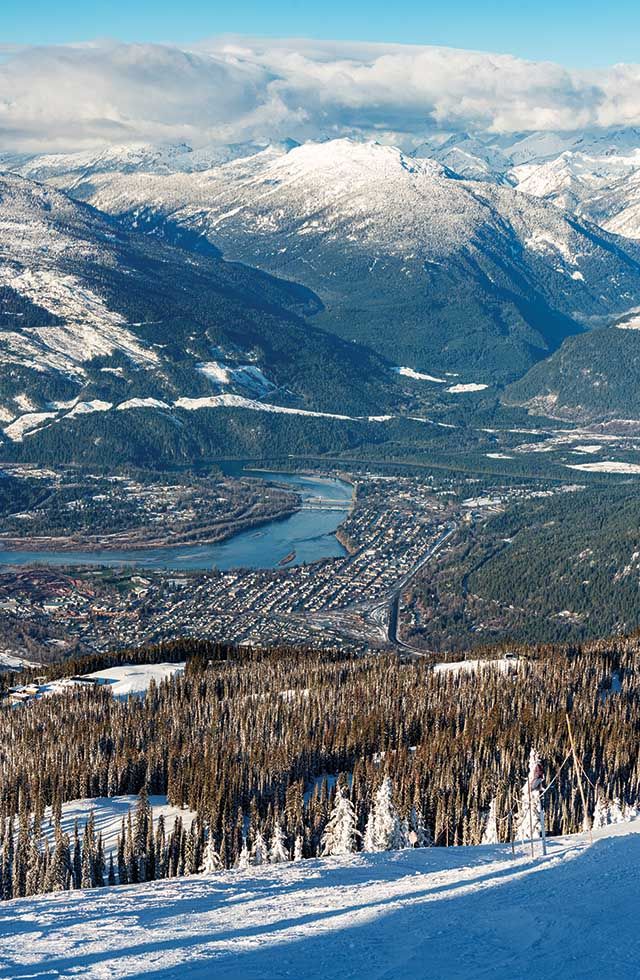
Revelstoke, aka Revy, sits in the northern reaches of the Kootenay Rockies. The Selkirks form the backbone of the resort, while the Monashees rise across the valley in the distance. The ski area averages roughly 10.5 metres (34 feet) of snowfall each winter, with surrounding peaks often seeing totals closer to 12–18 metres (40–60 feet), earning Revelstoke a reputation as one of Canada’s snowiest destinations. It’s a place defined by scale— geographic, vertical, historical. The same Ikon Pass we use at Blue Mountain unlocks the experience here—legs seasoned on Ontario groomers, put fully to the test. This is skiing stripped back to its essentials, amplified by terrain that demands your full attention.
The modern story of Revelstoke also has roots on the Escarpment. Osler Bluff Ski Club member Robert Powadiuk was among the early visionaries behind what would become Revelstoke Mountain Resort. Beginning in the early 1990s, Robert worked with a small group of investors to assemble the lands that now make up the resort, ultimately guiding the project through provincial, municipal, and First Nations approvals before it opened in 2007. Today, the family remains minority owners of the resort and its affiliated operations, including Selkirk Tangiers Heli Skiing. A lifelong skier who learned on the slopes of Blue Mountain more than six decades ago, Robert—along with his wife, Julia—now calls Collingwood home, a quiet through line that links Ontario ski culture to one of the country’s most ambitious resort projects.
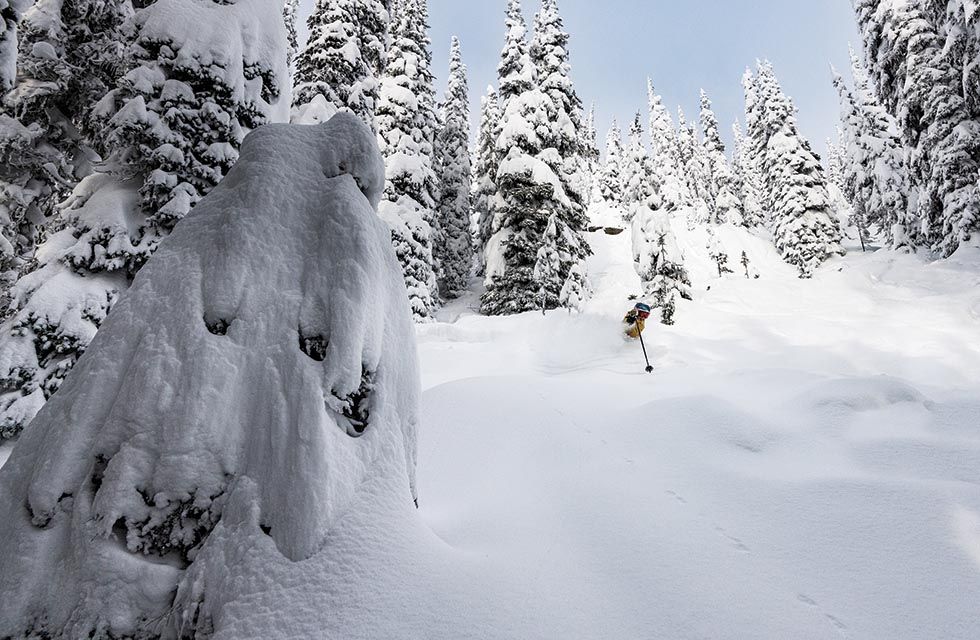
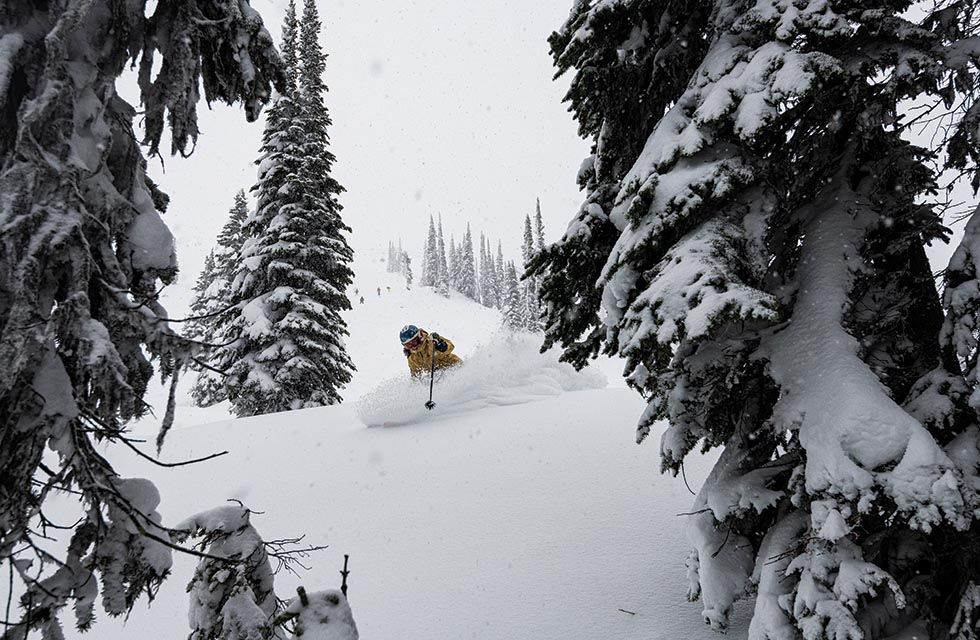
Cara Williams enjoying Revelstoke’s legendary powder pillows on a deep inbounds day.
Traveling to Revelstoke is all part of the experience. It’s approximately a two-and-a-half-hour drive from Kelowna International Airport, with direct flights available from Toronto. The route is spectacular—winding through mountain passes,
tracing long stretches of railway, and skirting the edge of history at Three Valley Gap, the preserved ghost town that sits just beyond the road. By the time you arrive, it already feels like you’re exactly where you’re meant to be.
The town predates the resort by more than a century. Founded in the late 1800s as a rail and forestry hub, Revelstoke grew alongside the Canadian Pacific Railway, its fate tied to the hammering of the Last Spike just west of town at Craigellachie. Originally named Farwell, it was rechristened Revelstoke in 1899 in honour of Lord Revelstoke, whose financial backing helped complete the railway that stitched the country together. That legacy lives on in The Last Spike, the longest ski trail in North America: a 15.2-kilometre (9.5-mile) green run that winds continuously from summit to base.
Skiing has been part of Revy’s identity since the 1890s. Scandinavian settlers brought the sport with them, founding the Revelstoke Ski Club and eventually building North America’s first ski jump in 1915. Legends followed. Nels Nelsen set a world record here in 1925 with a 250-foot jump. Isabel Patricia Coursier became a women’s world champion at just 15. Their stories aren’t museum pieces—they’re part of the fabric here, a lineage that still defines the town as a skier and snowboarder’s town.
Revelstoke Mountain Resort officially opened on December 22, 2007, and while the infrastructure continues to evolve, the feeling on the mountain remains refreshingly core. In many ways, it feels like resort skiing did in the mid-’90s—before everything was smoothed, scripted, and optimized. Cell service is spotty, which means work calls fade quickly into irrelevance. You’re here to ski. And ski you will.
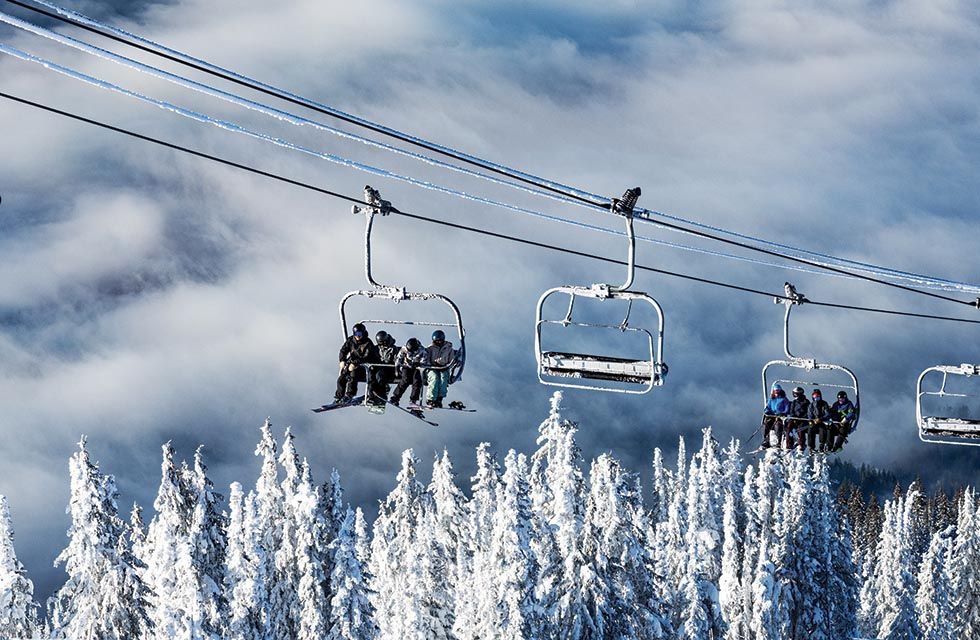
The Stoke Chair delivers riders straight into the heart of Revelstoke’s legendary terrain.
We were introduced to the mountain by a trusted guide. My old friend Joe Lammers is a former professional skier, avalanche forecaster, and ski patroller who left Whistler for Revy in 2007. Drawn by the North Kootenays’ snowpack and a community that still shreds for the fun of it, his connections now run deep—not just in the ski world. His transition into real estate has earned him a place among Royal LePage Revelstoke’s National Top 2% of agents for four consecutive years. When Joe said, “I know just where to take you,” we didn’t ask questions.
When we arrived, the mountain was coming off several days of storms—the kind that stack alpine snow quietly while you wait for ropes to drop. When the sun finally broke through, the stoke was unmistakable. Young locals whooped from the trees, highfiving at the bottom of runs, voices echoing through the glades. With 1,713 metres (5,620 feet) of vertical—the most in North America—Revy doesn’t ration its thrills. Pillow stacks rolled endlessly. Pow shots came on repeat. It’s big-mountain skiing, accessed straight from the chair, exactly as Joe promised. Despite its reputation, Revelstoke also offers plenty for beginner and intermediate skiers, with long, meandering runs that allow confidence to build gradually. It’s big terrain, but not an all-or-nothing proposition.
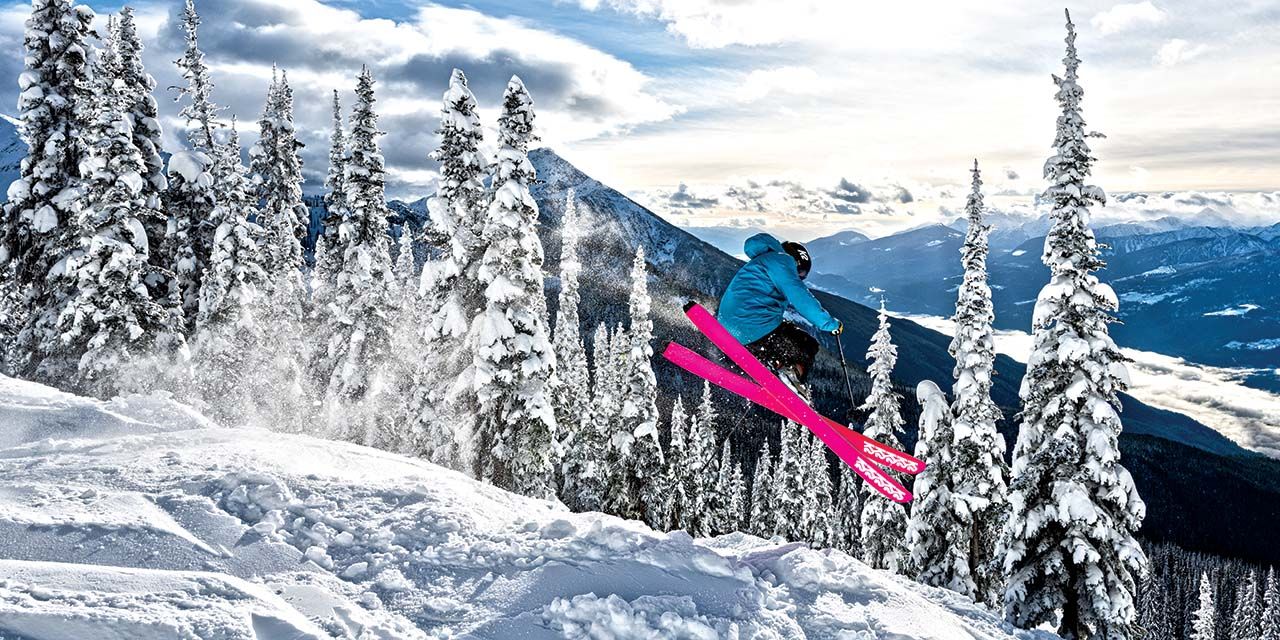
Later in the week, we connected with Mac Vibert, a 24-year old from Orillia who cut his teeth as a Georgian Peaks FIS racer before trading Ontario hardpack for B.C. powder. Now living here full-time, Mac skis the mountain with quiet confidence. While he launched himself off cliffs for Clay’s camera—allowing my feet to remain comfortably on the ground—he led us into both the North and South Bowls, opening up another layer of what makes this place so compelling.
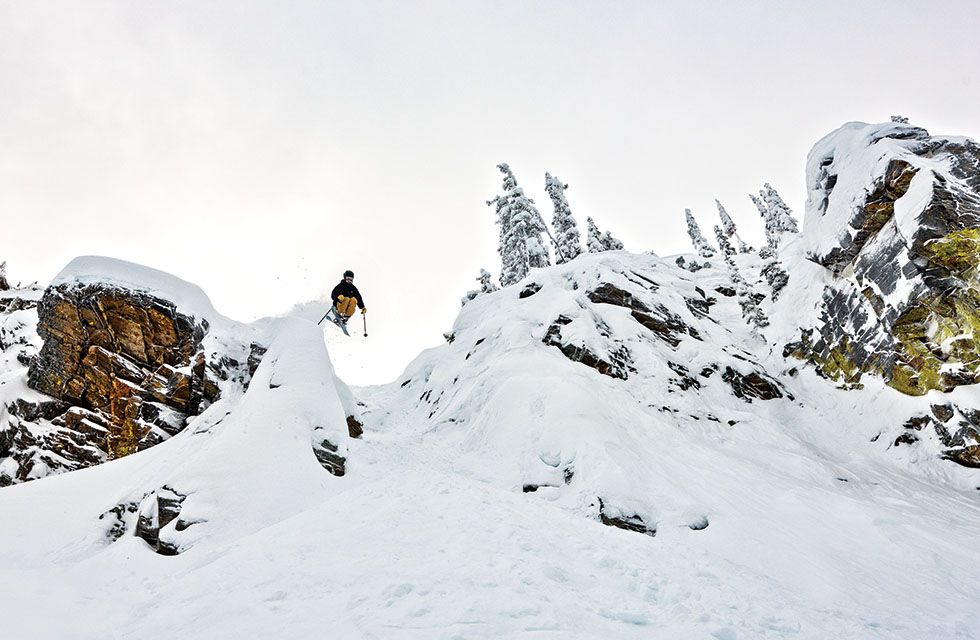
Mac Vibert takes flight into Revy’s North Bowl.
When we arrived, the mountain was coming off several days of storms—the kind that stack alpine snow quietly while you wait for ropes to drop.
The bowls here are vast and formidable. North Bowl is spoken about in reverent tones—its higher entrances demand commitment, but the payoff is snow that holds its quality longer than almost anywhere else on the mountain. On clear days, lines reveal themselves easily, from steep faces to playful features along the ridgelines. The more effort you invest, the more Revy gives back—this place rewards endurance and a willingness to work for it.
Lunch follows the same philosophy: keep moving. The Mackenzie Outpost near the top of the gondola is made for eatand- run refuelling—no frills, limited indoor seating, and skiers bellied up outside with burgers and beers, snow still clinging to their jackets. Lower down, Revelation Lodge offers a classic postand- beam ski lodge experience, while the base area delivers easy options like the Rockford Bar & Grill, Mackenzie Tavern, or La Baguette for something quick before heading back out.
We stayed slopeside at Sutton Place Hotel, the only true skiin, ski-out accommodation at the resort. Recently updated, the hotel blends modern comfort with a warm alpine vibe. Our twobedroom unit was spacious and well appointed—ideal for families or couples travelling together—with a full kitchen and a fireplace that earned its keep after long days on the hill. Outside, a heated pool, two hot tubs, saunas, and outdoor bar service created an easy, social end to the day.
Beyond lift-served skiing, Revelstoke has a reputation as a heli-skiing mecca. Pristine alpine terrain stretches in every direction. Backcountry ski and splitboard touring, Nordic skiing, and snowshoeing add to the sense that this is a true winter
hub—an ecosystem of adventure rather than a single alpine attraction. Snowmobiling is woven just as deeply into Revelstoke’s winter culture, opening access to vast alpine terrain that would otherwise require a helicopter to reach. We spoke with Mike Leblanc, president of Southwinds Marine Inc., a Collingwoodbased outfitter that specializes in fully guided backcountry snowmobile trips in Revelstoke. With deep roots in mountain riding, Southwinds works with experienced local guides—many with decades in avalanche control and professional operations— to introduce riders to the sport in a thoughtful, structured way. Trips are designed as complete packages, with sleds, safety gear, guiding, and avalanche education all handled on the ground. The result is access without intimidation—reframing backcountry snowmobiling not as an extreme pursuit, but as another immersive way to move through Revelstoke’s winter landscape.
The town mirrors that energy. Many of its early 20th-century buildings remain, lending downtown a railway-era charm that feels both nostalgic and alive. It’s eclectic, independent, and artistic. Locals know one another. There’s pride here—not the performative kind, but the earned kind that comes from living somewhere rugged, sometimes dangerous, and loving it deeply.
Change is coming, thoughtfully. The North Village at Revelstoke Mountain Resort is being developed into a fullservice basecamp, with expanded dining, shopping, lockers, and a mountain sports school. On-mountain improvements include a new summit building, expanded lodge decks, upgraded lifts, and enhanced snowmaking.
But even as Revelstoke grows, its essence remains intact. This is still a skier’s and snowboarder’s mountain—a place where the terrain leads, the community follows, and the positive energy never feels manufactured.
Revelstoke isn’t trying to be glossy—and it doesn’t have to. What stands out instead is an authenticity that feels increasingly rare, grounded in the raw pull of the mountain, the snow, and the shared joy of the day. It offers scale without spectacle and skiing that reconnects you to why this sport matters in the first place. The stoke here isn’t a slogan—it’s a current. And once you tap into it, you carry it with you long after the last run. E